
Cuisinart CJE-1000 vs Breville Juice Fountain Cold: the 5-speed against the seal-and-store jug
As an Amazon Associate, The Counter Lab earns from qualifying purchases. We do not do hands-on testing and we do not accept free units. Every figure below is a number Cuisinart printed in the CJE-1000 instruction booklet, a number Breville published on a page we opened, or a number a retailer listing printed for that exact model. When a page printed no figure, the table says so. No model-confirmed Amazon ASIN exists for these juicers in our verified files, so this post carries no buy buttons.
Macy’s sells the Cuisinart Juice Extractor (CJE-1000) at $229.95, read on Oct 10, 2026. Breville sells the Juice Fountain Cold (BJE430) at $199.95, read on breville.com on Oct 28, 2026. The price gap is $30.00, by our own arithmetic on the dated reads. Both machines are centrifugal juicers. Both print a 3-inch feed opening on the feature section of their pages. The split is in what each page prints around that shared core: a 5-speed dial with a printed pitcher and pulp volume on one side, and a jug that seals and stores juice on the other side.
One status note up front. Cuisinart’s own site carries no CJE-1000 product page that we could open, so the CJE-1000 figures here come from its instruction booklet and the same Macy’s listing. The Cold figures come from the Breville page, including its expanded Technical Specifications sections. Both prices in this post are dated above, and both are the reads used in our earlier gate-checked posts for these two models.
The two machines, on published figures

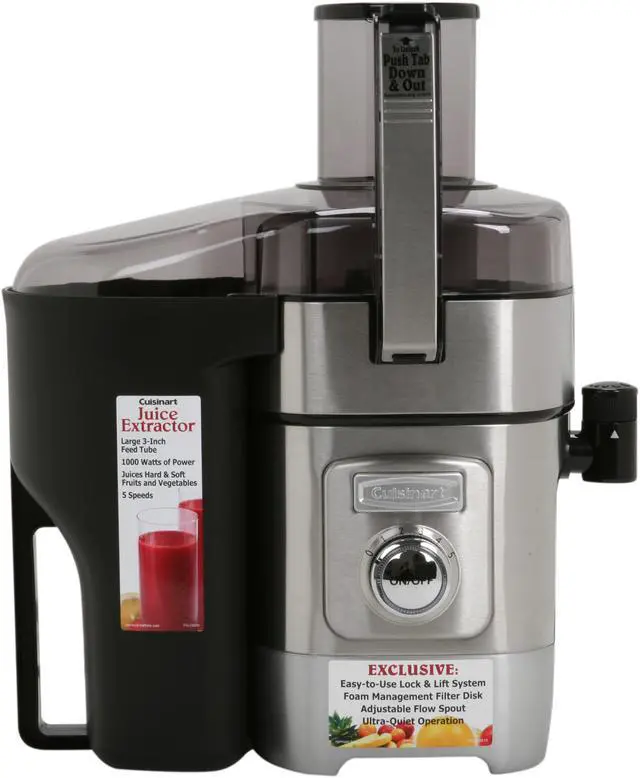
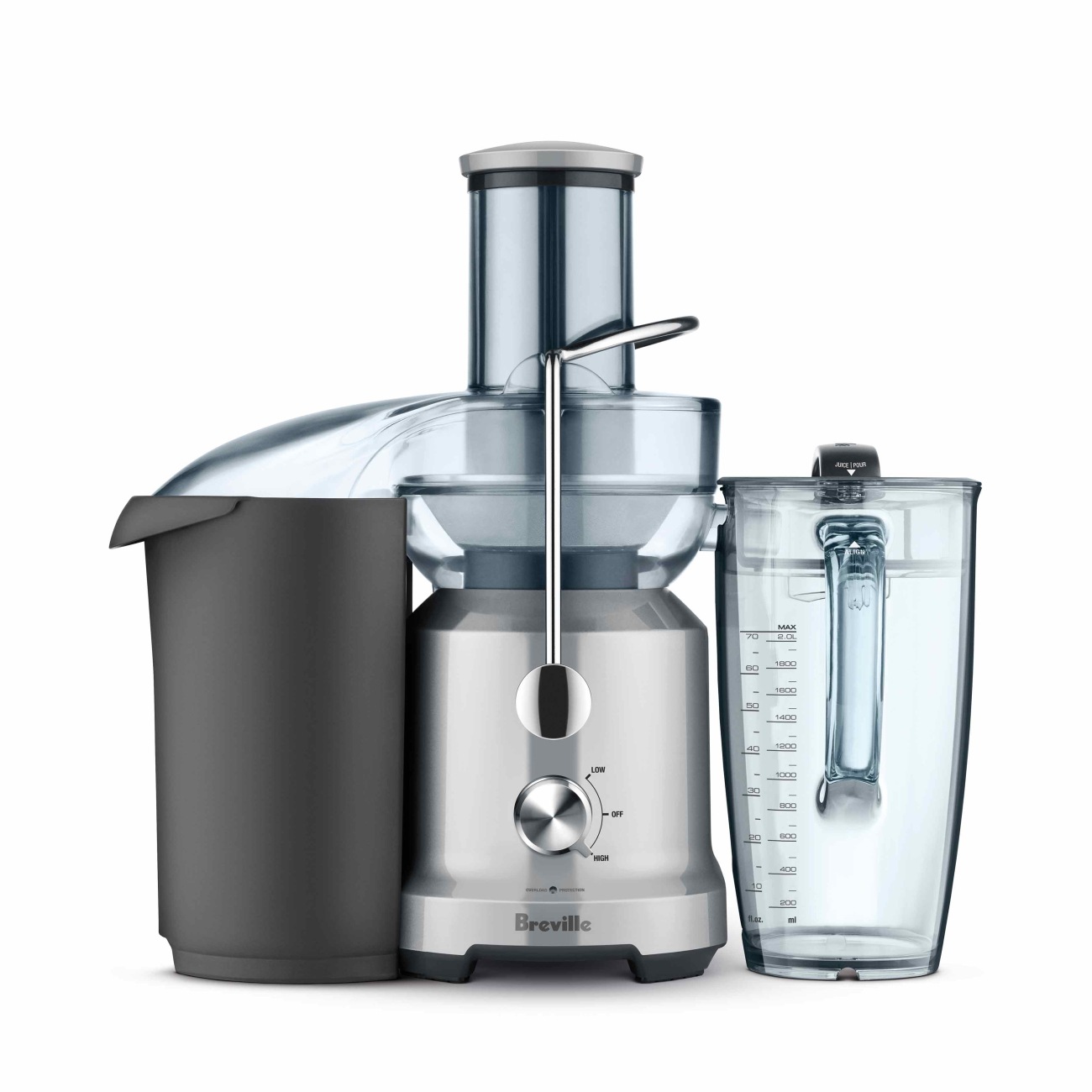

| Model | Price read | Motor | Speeds | Feed chute | Juice pitcher | Pulp container | Dimensions | Weight | Warranty |
|---|---|---|---|---|---|---|---|---|---|
| Cuisinart Juice Extractor (CJE-1000) | $229.95 at Macy’s, read Oct 10, 2026 | 1000 W | 5-speed dial control with blue LED light ring and On/Off button | 3-inch diameter feed tube | 1-liter juice pitcher | 2-liter pulp container | 16.46 in tall; 14.92 x 9.37 in base (retailer listing; the booklet prints no dimensions) | Not published in the booklet | 3-year limited |
| Breville Juice Fountain Cold (BJE430) | $199.95 at breville.com, read Oct 28, 2026 | 850 W motor | 2 speeds (High / low) | 3 in in the feature section; 3.5 in in the Technical Specifications | 70 oz Easy Seal Juice Jug with Froth Separator; seals and stores juice in the refrigerator for up to 3 days | 3.6 qt in Construction Materials; 3.4 (no unit) in the Capacity line | 13.6 x 8 x 16.7 in | 10.96 lbs | 1-year limited |
Where the printed figures split
The motor gap is 150 W by our own arithmetic: 1000 W against 850 W. The speed gap is a count gap: the booklet names 5 speeds on a dial with a blue LED light ring, and the Cold page names 2 speeds, High and low. A buyer who wants a named speed choice gets more named steps on the CJE-1000 page. A buyer who runs one speed for everything loses nothing that either page prints as a produce pairing, since neither page names a produce pairing for any speed in the sources used here.
The pitcher figures cannot be ranked directly. The booklet prints a 1-liter juice pitcher for the CJE-1000, and the Cold page prints a 70 oz jug. The two figures use different units, and this post does not convert one into the other. What can be compared is the wording around each vessel. The Cold jug carries a froth separator and seals and stores juice in the refrigerator for up to 3 days, in Breville’s words. The booklet prints no seal-and-store claim for the CJE-1000 pitcher. The CJE-1000 suits a batch poured from a pitcher at once. The Cold jug suits a batch made ahead and kept sealed.
The pulp figures cannot be ranked directly either. The booklet prints a 2-liter pulp container. The Cold page prints two different pulp figures: 3.4 with no unit in the Capacity line, and 3.6 qt in the Construction Materials list. We print both Cold figures and pick neither. The pulp verdict below rests on the fact that one side prints one volume in one unit, and the other side prints two figures that do not match.
Neither page prints an RPM figure, so no spin-speed comparison appears in the table. Neither page prints a yield figure, so no extraction ranking appears either. Watts on a centrifugal motor do not convert to juice yield, and no page here prints a number that would let yield be ranked, so the verdicts below rest on motor, speeds, vessel wording, size, and warranty as printed.
Two figures the Cold page prints twice, differently
The Cold page prints its feed chute as 3 in in the feature section and as 3.5 in in the Technical Specifications. It prints its pulp container as 3.4 with no unit in the Capacity line and as 3.6 qt in the Construction Materials list. We print both figures for each item and pick neither. The chute verdict below rests on the feature-section figure, which matches the CJE-1000 3-inch figure. The pulp figures are not ranked, because the Cold page itself prints two figures that do not agree.
Size on paper, and the warranty split
The Cold is the taller machine by 0.24 in: 16.7 in against 16.46 in, by our own arithmetic. That height rests on a retailer figure for the CJE-1000, since the booklet prints no dimensions, while the Cold height comes from the Breville page. The height gap is small enough that a cabinet measurement still decides it, and both machines need that measurement before purchase. The footprints run the other way on paper: 14.92 x 9.37 in is 139.80 sq in for the CJE-1000, against 13.6 x 8 in at 108.8 sq in for the Cold, a 31.00 sq in gap by our own arithmetic. The CJE-1000 takes the larger patch of counter on paper, even though it is the shorter machine by 0.24 in.
Weight gives no verdict here. The booklet prints no weight for the CJE-1000, so no weight gap is computed. The Cold weight of 10.96 lbs stands alone and ranks nothing. The warranty gap runs the other way from the price gap: the more expensive machine prints the longer term, 3 years limited against 1 year limited, a 2-year gap. Warranty is the one printed figure where the higher-priced machine leads outright.
Small features that split the pair
The booklet prints a foam management filter disk that fits in the filter bowl, an adjustable juice spout that controls the flow rate and closes to stop drips, a 4-second safety break that stops the filter basket when the handle tab is released, push-box cord storage, a cleaning brush for the filter basket, and dishwasher-safe removable parts. The Cold page prints Cold Spin Technology, which Breville describes as juice flowing up and through the cutting disc with less than 1.8 degrees F of heat transfer while extracting juice, in Breville’s words. The Cold page also prints a stainless steel micro mesh filter basket with stainless steel cutters, an LED display that lights when the motor stops from overloading, and a juice nozzle that inverts when finished to avoid drips. The Cold sources used here print no dishwasher-safe claim. Neither source prints a cord length figure, so no cord comparison appears in the table.
Per-case verdicts
For a batch made ahead and kept sealed: the Cold, on a 70 oz jug that seals and stores juice in the refrigerator for up to 3 days, against a 1-liter pitcher with no seal-and-store claim printed. The CJE-1000 pitcher serves a batch poured at once.
For speed choice on the page: the CJE-1000, on 5 named speeds against 2 named speeds. The booklet names no produce pairing for any speed in the parts list, and the Cold page names no produce pairing for either speed in the sources used here, so the verdict rests on the count alone.
For the lowest price in this pair: the Cold, at $199.95 against $229.95, with 850 W against 1000 W, 2 speeds against 5 speeds, and a 1-year term against a 3-year term. The trade is the missing speed steps, a jug volume printed in ounces rather than liters, and the shorter warranty.
For counter space on paper: the Cold, at 108.8 sq in against 139.80 sq in. Measure the counter before buying the CJE-1000, since its base is the wider of the two on paper, and measure the cabinet too, since both machines stand above 16 in tall.
For warranty: the CJE-1000, on a 3-year limited term against a 1-year limited term. Warranty is the one printed figure where the higher-priced machine leads by a full 2 years.
How we compared
Both price reads and every spec figure above come from pages opened for this site: the Cuisinart CJE-1000 instruction booklet (1000 W, 5-speed dial with blue LED light ring, 3-inch feed tube, 1-liter pitcher, 2-liter pulp container, adjustable spout, foam management disk, dishwasher-safe removable parts, 120 V) and the Macy’s CJE-1000M listing, read Oct 10, 2026 ($229.95, 3-year limited warranty, 3-inch feed tube, 5-speed dial), plus the Breville BJE430 page on breville.com, read Oct 28, 2026, including its expanded Technical Specifications sections ($199.95, 850 W, 2 speeds, 3 in feature section and 3.5 in Technical Specifications, 70 oz Easy Seal jug with froth separator and up to 3 days seal-and-store, pulp 3.6 qt and 3.4 with no unit, 13.6 x 8 x 16.7 in, 10.96 lbs, 1-year limited). The CJE-1000 height and base figures come from a retailer listing for the exact model, since the booklet prints no dimensions. No Amazon spec-table numbers were used, and no figure was estimated or converted between power units or between volume units. The price gap ($30.00), the 150 W motor gap, the 0.24 in height gap, the 31.00 sq in footprint gap, and the 2-year warranty gap are our arithmetic on published figures. Pulp capacity is not ranked, because the pages print different units or two figures that do not agree. This pair is distinct from our earlier posts on these models: the CJE-1000 against the Hamilton Beach Big Mouth, the Cold against the Big Mouth, the Cold against the Elite, and the Cold against the nutribullet Juicer Pro each compare a different pair, and no earlier post compares the CJE-1000 against the Cold directly.
For the wider juicer picture, see our best juicers guide and the juicers hub. For the other CJE-1000 pair, see CJE-1000 vs Big Mouth on published specs, and for the other Cold pair, see Cold vs Big Mouth on published specs. For how centrifugal machines differ from slow juicers, see centrifugal vs masticating on published specs.