
KitchenAid Artisan vs Professional 600: tilt-head vs bowl-lift, on published specs
As an Amazon Associate, The Counter Lab earns from qualifying purchases. We don’t do hands-on testing and we don’t accept free units. Every figure below is a number a brand or retailer published on a page we opened ourselves. When a page didn’t publish a figure, the table says so, and we never borrow a claim from a review site or a marketplace spec table.
KitchenAid’s two best-known home lines end up on the same shortlist: the Artisan 5-quart tilt-head and the Professional 600 6-quart bowl-lift. The mechanism is the structural difference between them. The printed figures matter too, but only after the watts and quarts are read for what they actually describe.
The two machines on published figures
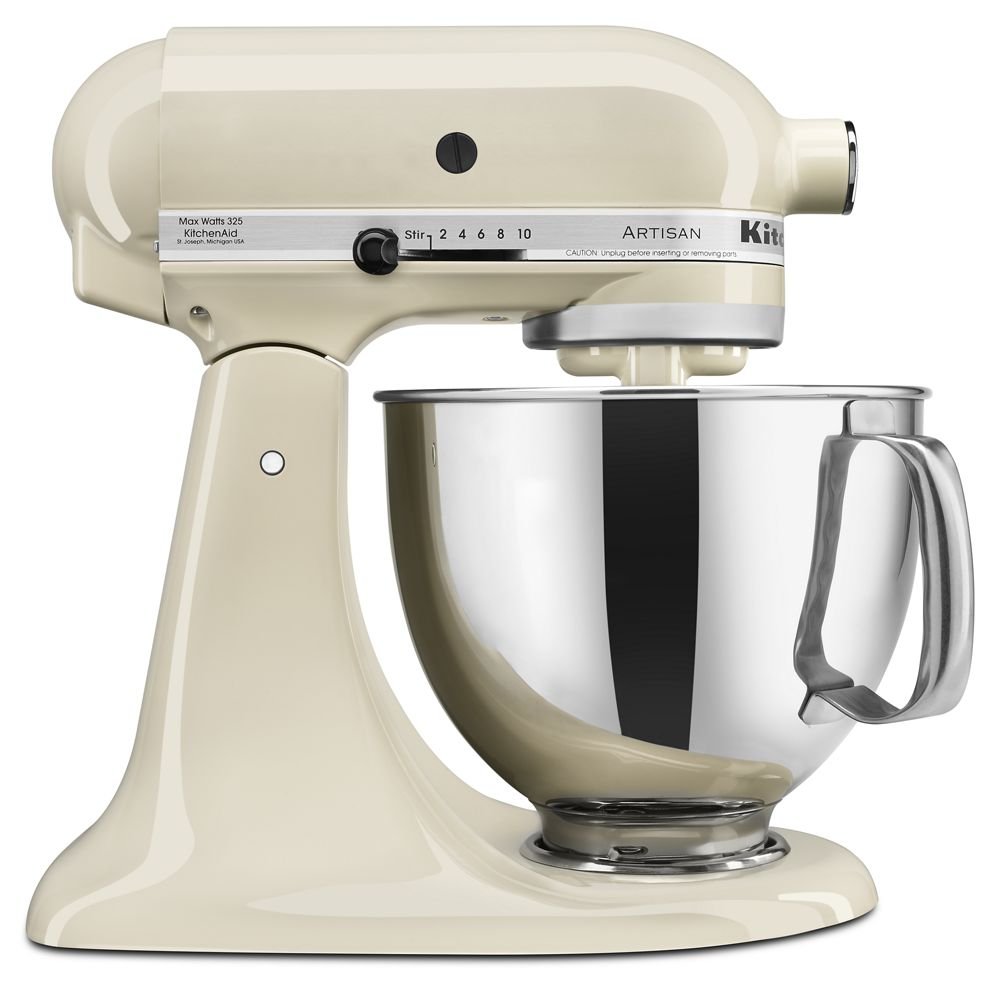

| Model | Bowl, as published | Power, as published | Mechanism, as published | Price read |
|---|---|---|---|---|
| KitchenAid Artisan Series 5-QT (KSM150PS) | 5 qt | 325 W | Tilt-head | $379.99 (list $499.99) at Best Buy, read Oct 10, 2026 |
| KitchenAid Professional 600 (KP26M1X) | 6 qt | 575 W | Bowl-lift | $549.99 at Wayfair, read Oct 10, 2026 |
Both publish 10 speeds. Both figures come from KitchenAid’s own comparison chart, cross-checked against the opened retailer pages. The Pro 600 costs $170 more than the Artisan at the prices we read.
What the tilt-head changes
The Artisan’s head swings back, so the bowl sits open for scraping and adding ingredients. That access is the tilt-head’s concrete advantage at the counter. The price of it is vertical space: the head needs clear room above the machine to swing, so measure under your upper cabinets before it becomes the default pick.
The printed numbers on the Artisan are modest in isolation. Five quarts is the mainstream home bowl. The published 325 W is a power-draw figure, not a measure of how the mixer moves dough. Ten speeds are the published count. The 20-plus color range on the opened page is a published fact too, and it matters to shoppers who keep the mixer on the counter: the Artisan is the line with the widest color choice in our data.
What the bowl-lift changes
The Professional 600’s head does not move. A crank raises the bowl under the fixed head, so nothing needs to swing above the machine, and the mixer can sit under upper cabinets without clearance planning. The bowl is 6 quarts, one quart above the Artisan. The published 575 W is 250 W more draw than the Artisan’s 325 W, printed in the same unit, so the two figures compare directly. Ten speeds, the same count.

The honest reading of the wattage gap: watts measure electrical draw. No page we opened published a torque figure for either machine, so the 250 W gap does not prove one mixer moves dough better than the other. The mechanism is the difference you can verify on paper: a fixed head and a cranked bowl for the Pro 600 against a swinging head for the Artisan.
The $170 question
$549.99 minus $379.99 is $170.00. That is the price of the move from the Artisan to the Professional 600 at the prices we read. On paper the $170 buys one more quart of bowl, a bowl-lift mechanism, and 250 W more published draw. It does not buy a published torque figure, and it does not buy a speed-count advantage: both list 10.
The Artisan’s own discount math is part of the same comparison. $499.99 minus $379.99 is $120.00, so the Artisan read $120 under its list price on the opened Best Buy page. The Pro 600’s $549.99 was the price on the opened Wayfair page for the KP26M1X variant, with no list price shown alongside it.
Verdicts by case
- If weekly bread dough decides it, the Professional 600 is the pick at $549.99. The bowl-lift’s fixed head is the sturdier brief for heavy dough, and the 6-quart bowl holds larger batches. The trade is $170 and a crank mechanism some cooks find slower to work around than a swinging head.
- If cakes, frostings, and occasional dough decide it, the Artisan is the pick at $379.99. The tilt-head gives open bowl access, the price read $120 under list, and the color range is the widest we verified. The trade is published power: 325 W of draw against the Pro 600’s 575 W, with no published torque figure to settle what the gap means in dough.
- If the bowl-lift appeals but $549.99 does not, the KitchenAid 5.5-Quart Bowl-Lift (KSM55) is the cheaper way into the mechanism at $299.99, read at Target on Oct 10, 2026. It publishes 500 W and 11 speeds. The trade is half a quart of bowl against the Pro 600.
- If 6 quarts will not be enough, the KitchenAid 7-Quart Bowl-Lift (KSM70SKXXBS) is the step above at $649.95, read at Crate & Barrel on Oct 10, 2026, with a published 500 W. The trade is another $100 over the Pro 600 for one more quart.

- If the mixer lives on the counter in a chosen color, the Artisan is the pick. The 20-plus color range on the opened page is not a small detail for a machine that never gets stored.
How we compared
Every figure above comes from a page we opened ourselves: KitchenAid’s own stand mixer comparison chart, Best Buy, Wayfair, Target, and Crate & Barrel, with prices read Oct 10, 2026. Where a page didn’t publish a figure, the table says so. We don’t do hands-on testing and we don’t accept free units; when we start testing, this page will say so. This post carries no buy buttons: we link Amazon only for models whose ASIN we’ve confirmed against the exact model number, and no model-confirmed ASINs exist for these two mixers.
Next step: see where both land in our best stand mixers guide, browse every spec-checked model on the stand mixers hub, read the same two machines in our nine-model bowl-size and wattage comparison, or read the same watts problem in blenders in our blender watts vs horsepower explainer.