
Hurom H70 vs Hurom H80: the $503.10 Easy Clean against the $749.00 XL hopper, on published specs
As an Amazon Associate, The Counter Lab earns from qualifying purchases. We do not do hands-on testing and we do not accept free units. Every figure below is a number Hurom published on a page we opened ourselves on Nov 12, 2026, or in the official H70 manual linked from the Hurom store. When a page did not publish a figure, the table says so, and we never borrow a claim from a review site or a marketplace spec table. No model-confirmed Amazon ASIN exists for these juicers in our verified files, so this post carries no buy buttons.
Two Hurom slow juicers sit $245.90 apart on our subtraction, and the gap depends on a code. The H70 Easy Clean Slow Juicer reads $503.10 at hurom.com with code HEALTH at checkout, with $559.00 struck through and a $649.00 compare-at struck through beside it. The H80 Slow Juicer reads $749.00 at hurom.com with no compare-at price beside it. Both print the same 150 W motor at 120 V, the same 15-year warranty, the same 1.4 m cord, and the same 30-minute continuous-use limit. The split is feed and cleaning: the H70 prints a strainer-free two-part auger and a 45 mm chute opening, while the H80 prints a 2.2 L hopper behind a 136 mm opening, three strainers, and dishwasher-safe parts. Neither brand page publishes a juice-yield figure or the juice and pulp container sizes, so this comparison rests on price, feed, speed, run time, counter fit, cleaning, and dated prices, not on output claims.
The two machines, on published figures
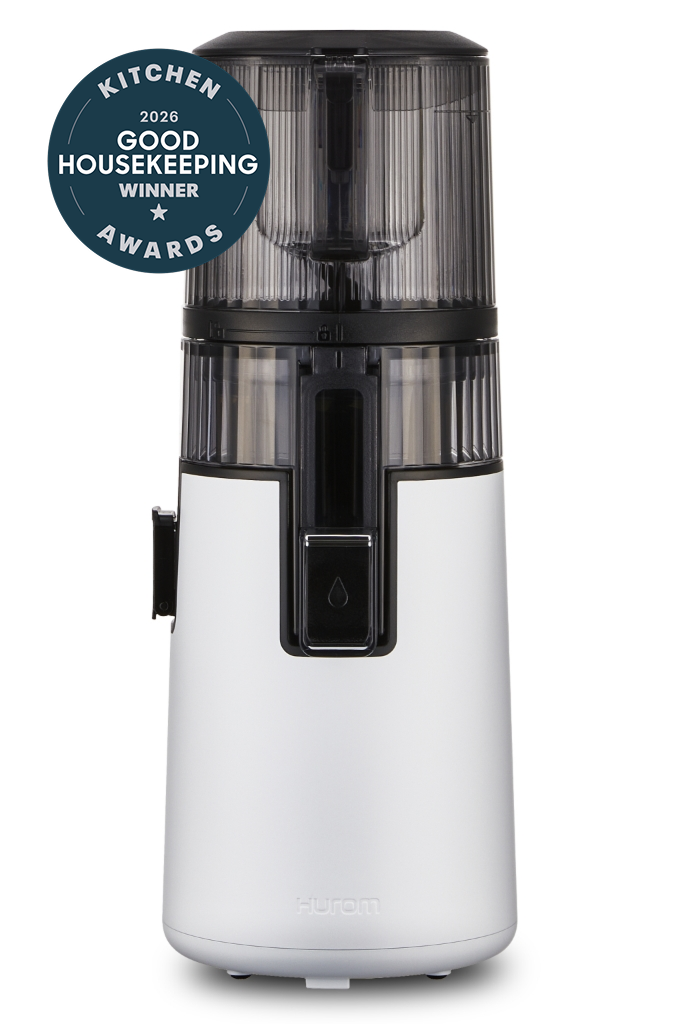
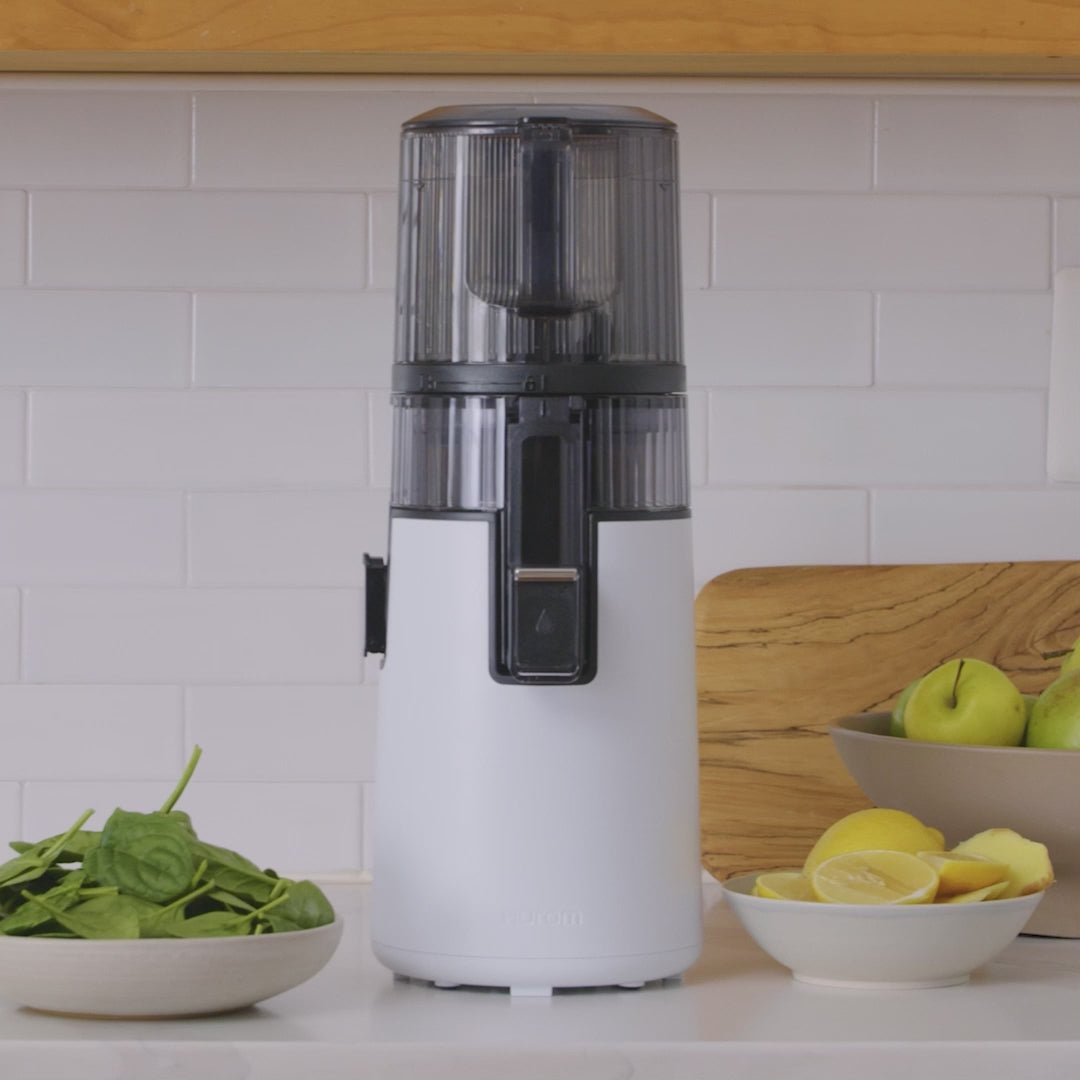
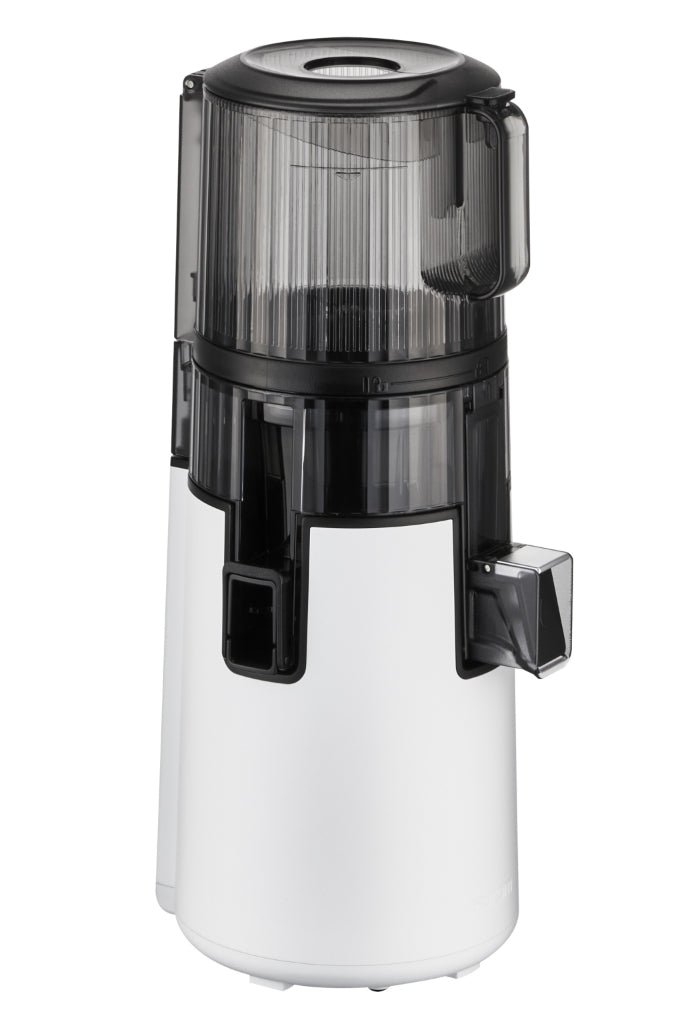


| Model | Price read | Speed and motor | Feed and containers | Run time | Warranty | Size and weight | Cleaning |
|---|---|---|---|---|---|---|---|
| Hurom H70 Easy Clean Slow Juicer | $503.10 sale with code HEALTH at checkout at hurom.com, read Nov 12, 2026; $559.00 struck through; compare-at $649.00 struck through; Add to Cart button present and enabled; no stock wording printed on the page | 60/70 RPM auger; 150 W; 120 V, 60 Hz; A/C motor | Chute opening 45 mm (1.8 in); chamber 450 ml (15.2 oz); hopper volume not published; juice container and pulp container sizes not published | Up to 30 minutes continuously (page); the manual adds a 5-minute auto-stop timer, press the switch again to restart, and a break of over 5 minutes after long use | 15 years, motor and parts (page); the manual header reads “Warranty not included” | 174 x 216 x 436 mm (6.8 x 8.5 x 17.2 in); 6.7 kg (14.8 lb); page and manual agree on weight | Page makes no dishwasher claim; manual says wash parts with a cleaning brush under running water, hand-wash only; strainer-free two-part auger |
| Hurom H80 Slow Juicer | $749.00 at hurom.com, read Nov 12, 2026; no compare-at price printed; Add to Cart button present and enabled; no stock wording printed on the page | 50 RPM auger; 17 RPM spinning brush; 150 W; 120 V, 60 Hz; A/C motor | Hopper 2.2 L (74.4 oz); chute opening 136 mm (5.4 in); chamber 500 ml (16.9 oz); juice container and pulp container sizes not published | Up to 30 minutes continuously | 15 years, motor and parts | 26.3 x 24.5 x 45.7 cm (10.4 x 9.6 x 18.0 in); 6.2 kg (13.7 lb) | Page calls parts dishwasher safe but does not name which parts or state restrictions; three strainers included: fine, coarse, and ice cream |
Price: a code, a struck price, and a $100 climb
The bank framing did not survive this run. The bank held the H70 at $559.00 with a $649.00 list price and the H80 at $649.00 with a $749.00 list price, both from the Oct 10, 2026 collection read. On Nov 12, 2026, the H70 page prints $503.10 in green with code HEALTH at checkout, $559.00 struck through, and $649.00 struck through as the compare-at. The H80 page prints $749.00 with no compare-at beside it. The H80 has climbed $100.00 since the Oct 10 read, or 15.4 percent on our arithmetic, and now sits at the number the bank held as its list price. The H70 discount is $55.90 off the $559.00 struck price, or 10.0 percent, and it only applies with the code at checkout.
The gap between the two machines is therefore two numbers, not one. With the H70 code applied, the gap is $245.90 on our subtraction ($749.00 minus $503.10). At the H70 struck price without the code, the gap is $190.00 ($749.00 minus $559.00). A buyer who forgets the code pays $55.90 more for the H70 and closes the gap by the same amount. Neither page prints an explicit stock label, so no stock claim appears here; both pages show an enabled Add to Cart button and nothing more on availability. Per chamber millilitre, the H70 costs $1.12 at the code price ($503.10 divided by 450 ml) against $1.50 for the H80 ($749.00 divided by 500 ml), and $1.24 at its struck price.
Feed: a 45 mm opening against a 136 mm opening
The feed opening is the widest printed split in the table. The H70 chute opening prints 45 mm (1.8 in), and the H80 chute opening prints 136 mm (5.4 in), a 91 mm gap, or 3.02 times wider on our arithmetic. The H80 hopper holds 2.2 L (74.4 oz) as printed, while the H70 hopper volume is not published anywhere on its page or in its manual. Both pages claim the largest hopper in their own words, and only the H80 number lets a buyer test the claim, since the H70 volume is not printed. The chamber split is smaller: 500 ml (16.9 oz) for the H80 against 450 ml (15.2 oz) for the H70, a 50 ml gap.
What the H70 feed lacks in width, its chamber design answers in parts. The H70 uses a strainer-free two-part auger, so there is no mesh strainer to scrub, and its page prints a gauge window on the front of the chamber for watching juice production. The H80 uses a conventional strainer set instead: a fine strainer for clearer texture, a coarse strainer for a mix of juice and pulp, and an ice cream strainer for frozen desserts. The H80 page also names spiral blade technology that helps prevent clogging from fibrous vegetables and citrus, a claim the H70 page does not make. Neither page prints the juice or pulp container sizes, so no batch-size verdict rests on containers here.
Cleaning: strainer-free and hand-wash against dishwasher-safe and three strainers
Cleaning is the second sharp split, and it runs in opposite directions on the two pages. The H70 page makes no dishwasher claim at all, and its manual says to wash the parts with a cleaning brush under running water, wipe the body with a damp towel or soft cloth, and sterilize by soaking in warm water with baking soda, citric acid, or vinegar. That is hand-wash only, from the manual, and the manual never mentions a dishwasher. The H70 buyer who wants fewer parts to wash gets the strainer-free auger, and the buyer who wants the dishwasher gets no printed permission.
The H80 page prints the opposite headline: dishwasher-safe parts, described as the first home juicer with dishwasher-safe parts. The page does not name which parts are dishwasher safe and states no restrictions, so the permission is broad on the page and thin on detail. The H80 buyer also gets three strainers to wash instead of none, plus a spinning brush at 17 RPM that the H70 page lists as not applicable. A buyer who counts parts will wash more pieces on the H80 side, and a buyer who counts dishwasher trips will find the only printed permission on the H80 side.
Controls and run time
Speed prints a small split with the H70 on top. The H70 auger prints 60/70 RPM against the H80 at 50 RPM, so the H70 turns 10 to 20 RPM faster on printed figures, or 20 percent faster at 60 RPM and 40 percent faster at 70 RPM. Both machines print the same 150 W motor at 120 V, 60 Hz, so the motor figure does not explain the $245.90 gap. Both pages print quiet wording with no decibel figure beside it, so no quiet ranking appears here.
Controls differ in form. The H70 page does not describe its controls in the page text; the manual prints a rocker switch on the body with ON, stop, and REV, where REV works only while the button is pressed. The H80 page names a control dial with forward and reverse, visible as a round dial on the body in the photos. Both pages print the same continuous-use limit: up to 30 minutes. The H70 manual adds a 5-minute auto-stop timer not mentioned on the page, with a restart by pressing the switch again, and says that more than 30 minutes of operation may stop the machine until the motor cools down, with a break of over 5 minutes after long use. The H80 page links no manual, so no manual cross-check was possible for the H80.
Size on paper
The H80 takes the larger patch of counter on published figures. Its footprint is 10.4 x 9.6 in, or 99.84 sq in on our arithmetic, against the H70 at 6.8 x 8.5 in, or 57.8 sq in, a 42.04 sq in gap. The H80 also stands taller at 18.0 in against 17.2 in, a 0.8 in gap on our subtraction. Both need tall under-cabinet clearance, and neither fits a low cabinet shelf on published height. Weight runs the other way: the H70 prints 6.7 kg (14.8 lb) against the H80 at 6.2 kg (13.7 lb), so the smaller-footprint H70 is 1.1 lb heavier on printed figures. Both print the same 1.4 m (4.6 ft) removable cord.
Color choice also splits. The H70 page lists White and Matte Black, while the H80 page lists White, Matte Black, and Kale. The H80 box lists three strainers and a spinning brush among its included parts, while the H70 box lists a two-part auger, a cleaning brush, and a manual and recipe book. Both boxes list a juice container, a pulp container, a pusher, a hopper, a chamber, and a power cord.
Two figures the brands print twice, differently
The H70 warranty is the first conflict. The H70 page promises that the motor and parts are covered by a 15 year warranty, while the manual linked from the same page carries a header reading “Warranty not included” beside “Home use only”. We print both, and the page warranty is the one a buyer sees at checkout. The manual also names the product line as the H70FT Series, and the collection lists a separate H70FT Easy Clean Slow Juicer at $449.00; this post covers the H70 Easy Clean Slow Juicer listing at $503.10 with code HEALTH, not the H70FT listing.
The second conflict is the H70 shipping dimensions, which we do not use. The page prints shipping dimensions of 440 x 230 x 465 mm beside inch figures of 15.7 x 9.1 x 18.3 in, and the two sets do not agree with each other in order, since 440 mm is about 17.3 in, not 15.7 in. The product dimensions agree with each other and are the ones used in the table. The third conflict is the hopper claim: both pages claim the largest hopper in their own words, and only the H80 quantifies it at 2.2 L. The H70 hopper volume is not published, so the two claims cannot be ranked on printed figures.
Per-case verdicts
Strainer-free cleaning and the lower price, with the code: the Hurom H70, at $503.10 with code HEALTH, with a strainer-free two-part auger, a 60/70 RPM turn rate, and a 57.8 sq in footprint. The buyer accepts the 45 mm chute opening, hand-wash-only cleaning per the manual, the 5-minute auto-stop timer, and the unpublished hopper volume.
The wide hopper and dishwasher-safe parts, at the higher price: the Hurom H80, at $749.00, with a 2.2 L hopper behind a 136 mm opening, three strainers including an ice cream strainer, a round forward-and-reverse dial, and a printed dishwasher-safe claim. The buyer accepts the $245.90 gap with the code applied, the 50 RPM turn rate, and the 99.84 sq in footprint.
Whole produce with less cutting, or sorbet from frozen fruit: the Hurom H80, with the 136 mm opening against 45 mm and the ice cream strainer the H70 does not list. A buyer who juices whole apples or makes frozen desserts from the included strainers finds both features only on the H80 side as printed.
How we compared
Both price reads and every spec figure above come from pages opened Nov 12, 2026: the Hurom H70 Easy Clean Slow Juicer page on hurom.com ($503.10 sale with code HEALTH, $559.00 struck through, compare-at $649.00 struck through, Add to Cart enabled, 60/70 RPM, 150 W, 120 V, 45 mm chute opening, 450 ml chamber, 174 x 216 x 436 mm, 6.7 kg, 15-year warranty, up to 30 minutes continuously) and the H70FT Series user manual linked from that page (6.7 kg, rocker switch ON/O/REV, 5-minute auto-stop timer, hand-wash only, “Warranty not included” header), plus the Hurom H80 Slow Juicer page on hurom.com ($749.00, Add to Cart enabled, 50 RPM, 17 RPM spinning brush, 150 W, 120 V, 2.2 L hopper, 136 mm chute opening, 500 ml chamber, 26.3 x 24.5 x 45.7 cm, 6.2 kg, 15-year warranty, up to 30 minutes continuously, dishwasher-safe parts). The H80 page links no manual, so no manual cross-check was possible for the H80. No Amazon spec-table numbers were used, and no figure was estimated or converted between power units or between volume units. The price gaps ($245.90 with the code, $190.00 at the struck price), the $55.90 and 10.0 percent H70 discount, the $100.00 and 15.4 percent H80 climb, the 91 mm chute gap, the 50 ml chamber gap, the 42.04 sq in footprint gap, the 0.8 in height gap, the 1.1 lb weight gap, and the $1.12 and $1.50 per chamber millilitre figures are our arithmetic on published figures. Neither machine carries a buy button here because no model-confirmed ASIN exists in our verified files for either model, so we never guess one. This pair is distinct from our earlier posts on these models: the H310 against the H400 and H-AA ladder, the H200 against the H310, and the Nama J2 against the Hurom H400 each compare a different pair, so no earlier post compares the H70 against the H80 directly.
For the wider juicer picture, see our best juicers guide and the juicers hub. For the H200 against the H310, see Hurom H200 vs H310. For the Nama J2 against the Hurom H400, see Nama J2 vs Hurom H400. For how feed chutes are sized across brands, see slow-juicer feed chutes decoded, and for the green-juice class around these prices, see best slow juicers for leafy greens under $500. For the mechanism split behind both machines, see juicers: centrifugal vs masticating, and for the celery case slice, see best juicers for celery.