
Philips NA350 vs Cosori Dual Blaze: two baskets against dual heat
As an Amazon Associate, The Counter Lab earns from qualifying purchases. We do not do hands-on testing and we do not accept free units. Every figure below comes from a brand page or an official manual opened for this post, and every price carries its retailer and read date. When a page printed no figure, this post says so, and it does not fill the gap from another model or from a marketplace spec table. This post carries no buy buttons, since no model-confirmed ASIN exists in our verified files for either machine here, so we never guess one.
Philips and Cosori answer the same dinner problem in opposite ways. Philips splits the fryer into two baskets, each with its own temperature and time, so a main and a side can finish together. Cosori keeps one basket and puts a heating element above and below the food, so both sides cook without a mid-cook shake. The price gap between the two machines is $120.99, our subtraction on $249.99 and $129.00, and the rest of this post checks what that gap buys, and what it does not.
The two machines, on published figures
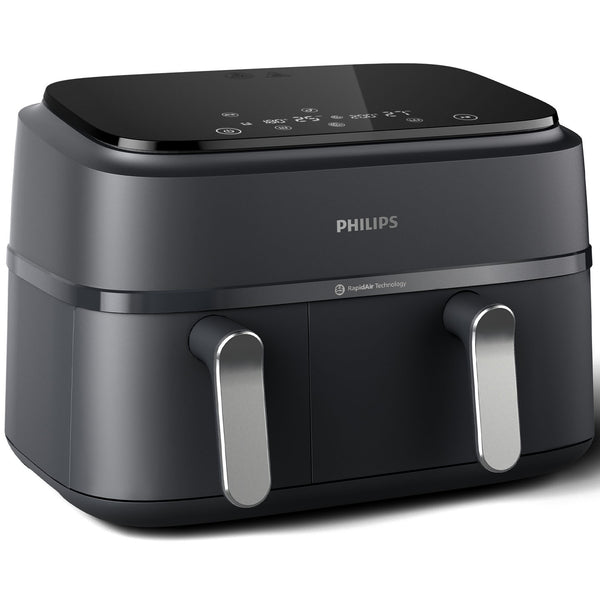
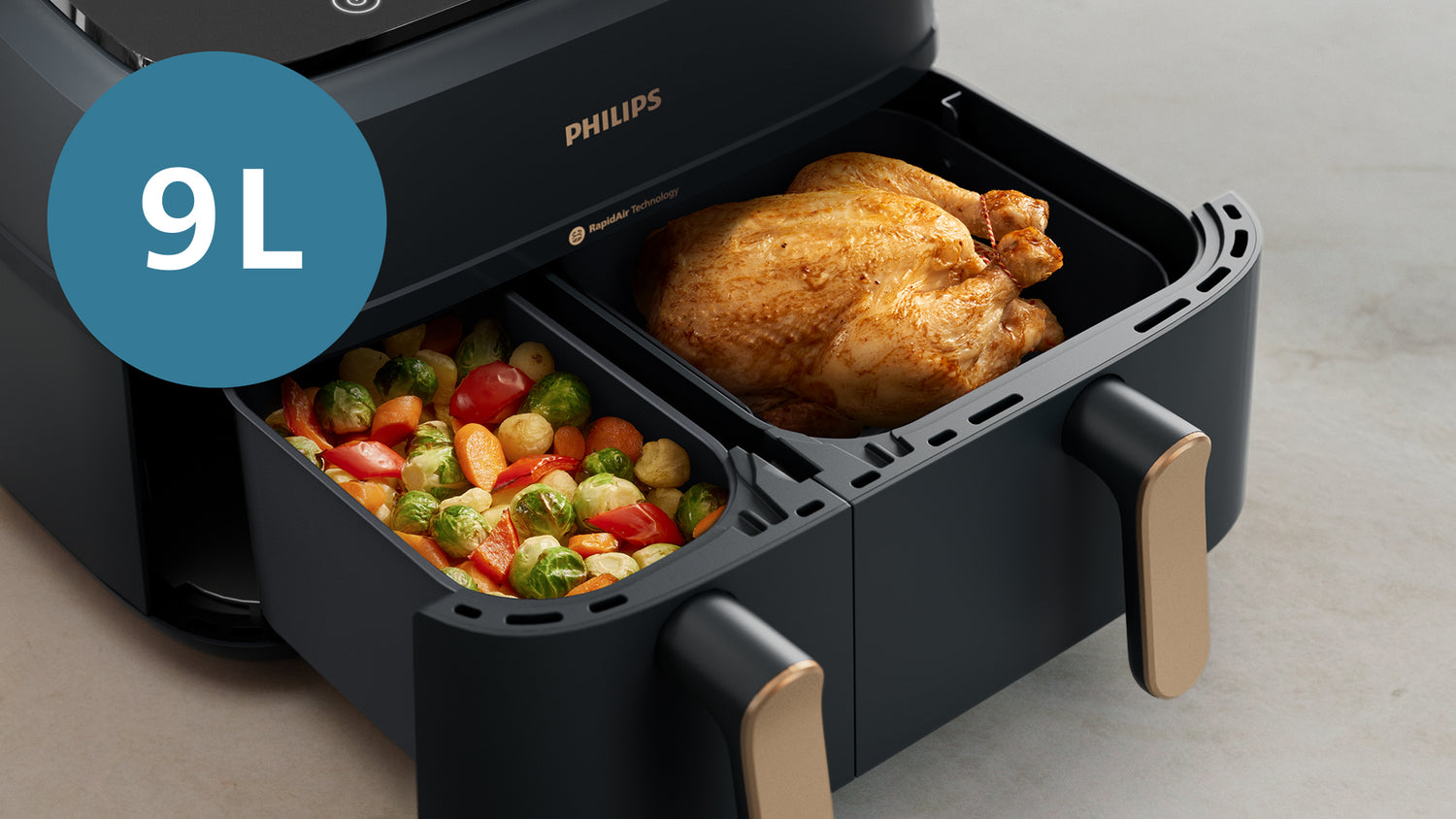
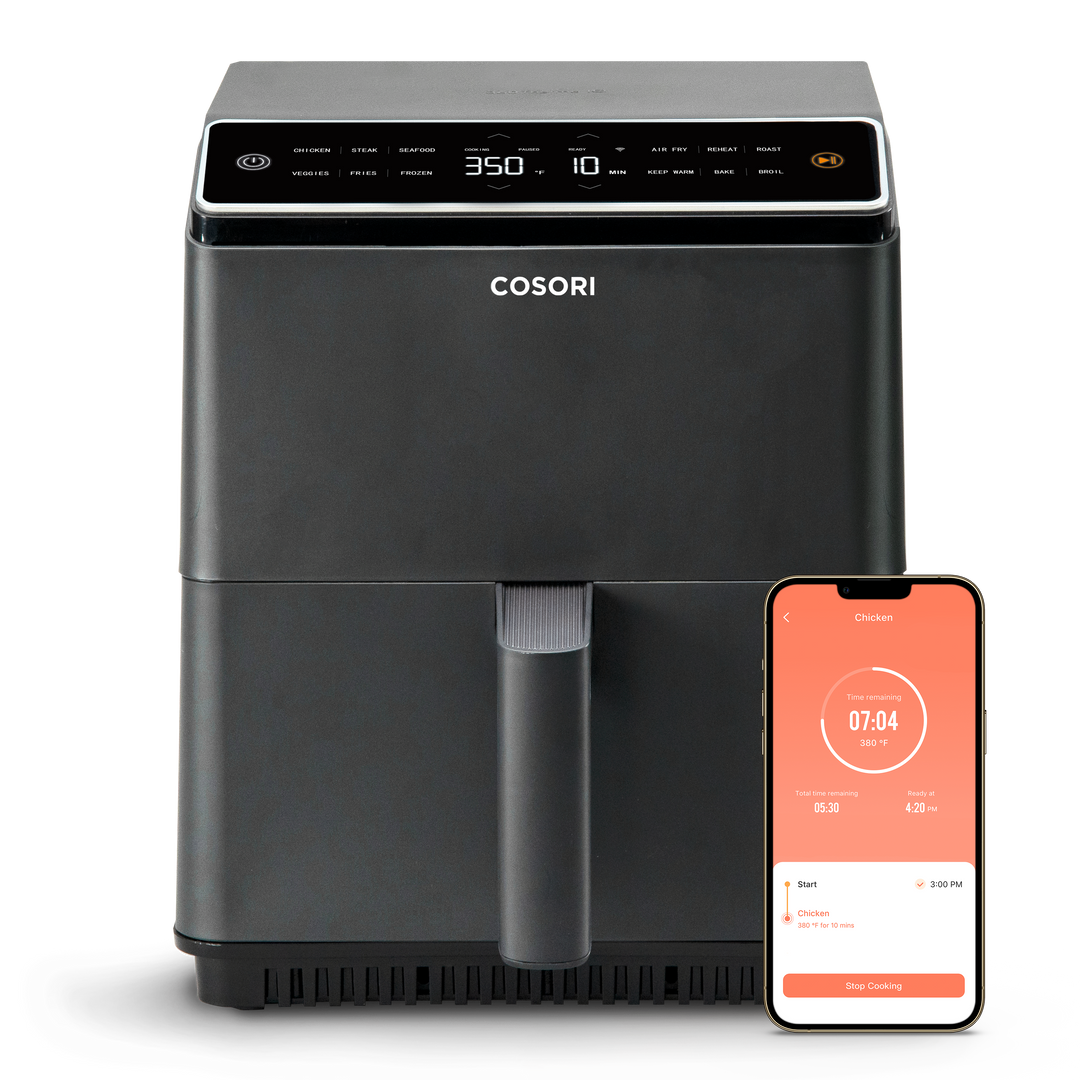
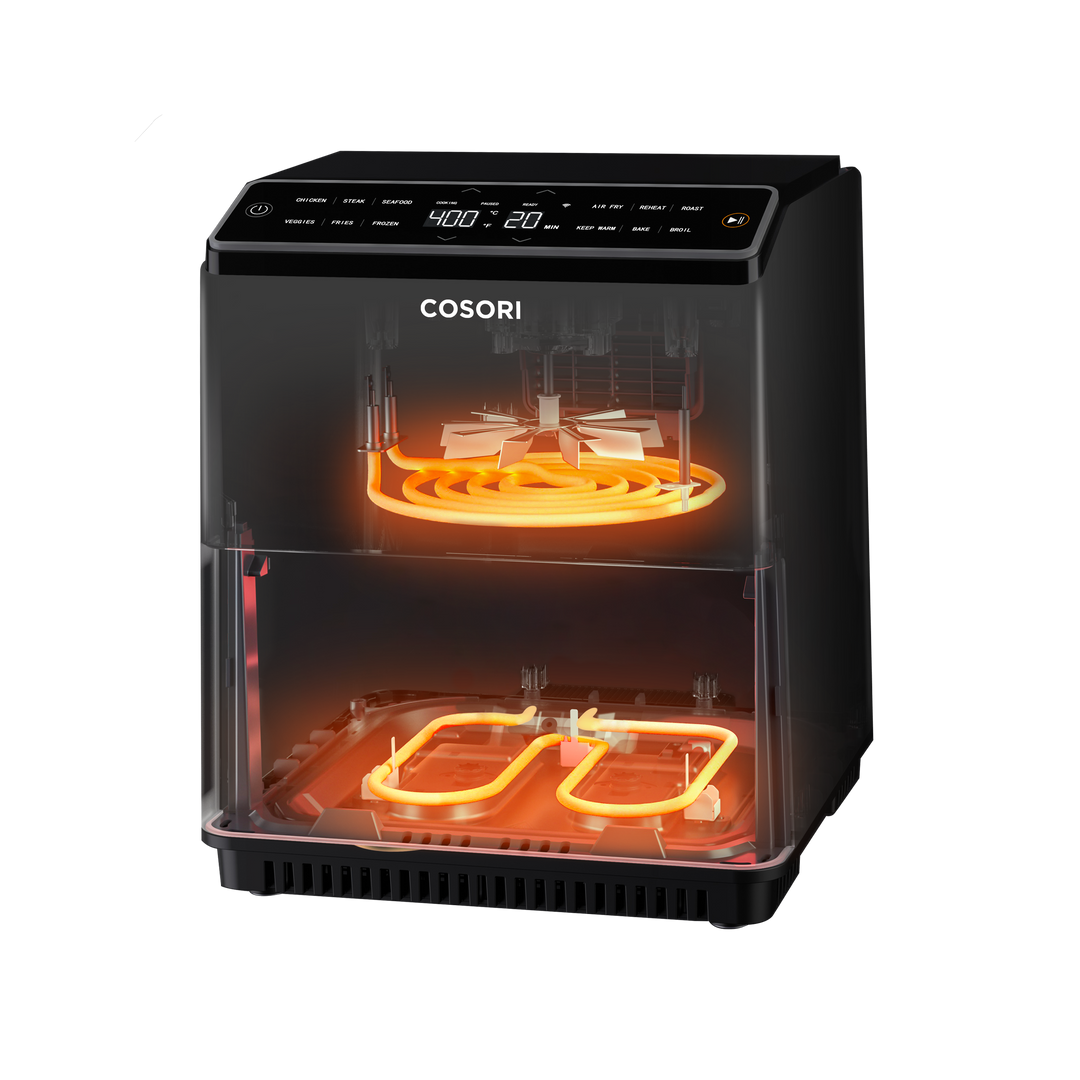
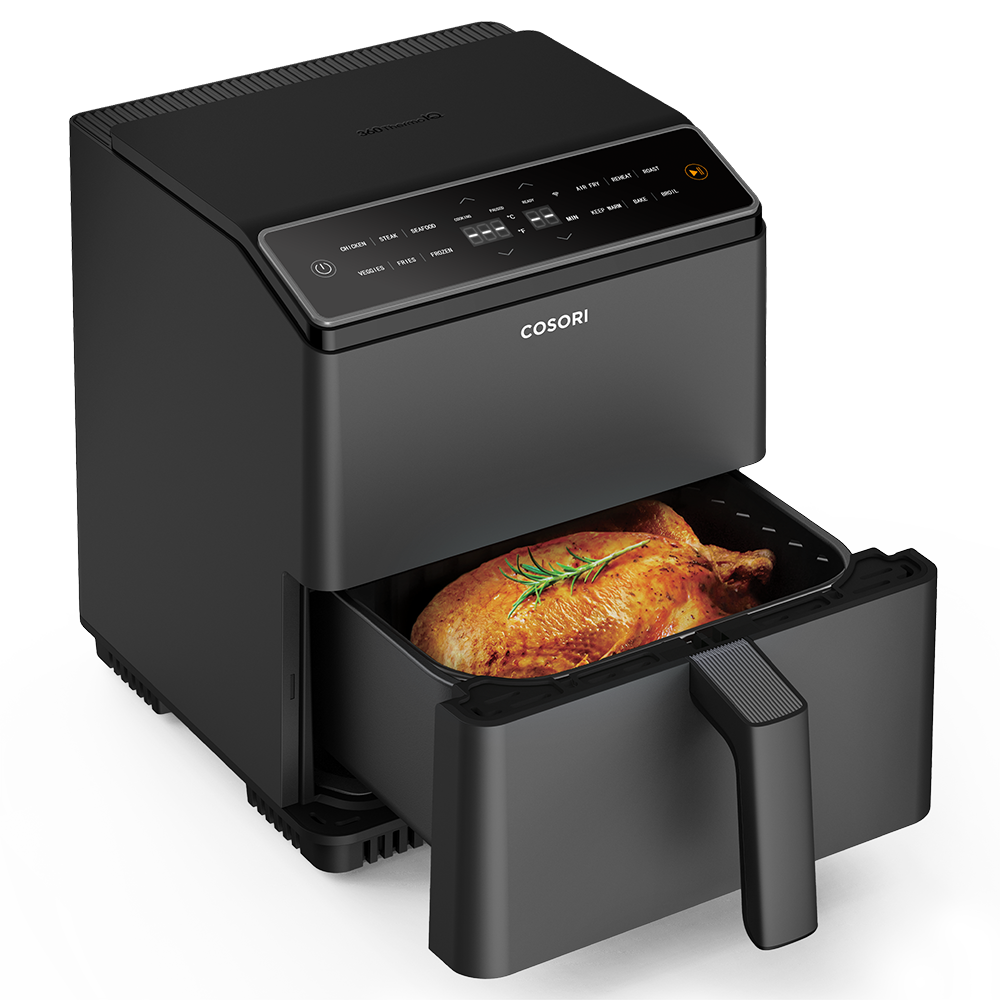
The Philips machine is the 3000 Series Dual Basket Airfryer (NA350/NA351). The US store page lists SKU NA351_00 for this dual-basket listing, and this post uses that listing for the Philips figures. The Cosori machine is the Dual Blaze 6.8-Quart Smart Air Fryer (CAF-P583S-KUS). Its wattage and temperature range come from its official user manual, and its price and function list come from cosori.com.
| Spec | Philips 3000 Series Dual Basket (NA350/NA351) | Cosori Dual Blaze 6.8-Quart Smart (CAF-P583S-KUS) |
|---|---|---|
| Capacity | 9.5 qt total (9L), 6L large drawer + 3L small drawer; large drawer fits up to 1.5 kg | 6.8 qt / 6.4 L, serves 4-6 people per the manual |
| Basket layout | Two baskets, each set to its own temperature and time, with a finish-together setting | One basket with a crisper plate, dual heating elements above and below the food |
| Wattage | Not published on the US store page opened | 1,750 W, AC 120V, 60Hz, per the manual |
| Temperature range | 140-400 F, per the page FAQ | 175-400 F, per the manual |
| Functions and presets | 8 presets: fresh fries, frozen fries, chicken, meat, veggies, fish, cake, and reheat | 12 functions: Chicken, Steak, Seafood, Veggies, Fries, Frozen, Air Fry, Reheat, Roast, Keep Warm, Bake, and Broil |
| Time range | Not published on the US store page opened | 1-60 min, per the manual |
| Dimensions | 15 in deep x 17.4 in wide x 12.3 in high | 11.7 x 12.9 x 13.8 in, per the manual |
| Weight | 17.3, with no unit printed in the spec block | Not printed on the cosori.com product page opened |
| Voltage | 120, per the spec block | AC 120V, 60Hz, per the manual |
| App and voice | HomeID app named on the page for recipes and tips, with no remote-control claim printed | VeSync app for remote control and recipe settings, with Alexa and Google Assistant voice control |
| Cleanup | Nonstick coating and dishwasher-safe removable parts, per the page | Basket and crisper plate listed in the box, with no dishwasher claim printed on the product page opened |
| Warranty | Two Year Warranty, per the page badge | 2-year limited warranty, per the cosori.com page |
| Price | $249.99 at Philips Home Appliances US, read Nov 1, 2026 | $129.00 at cosori.com, read Nov 1, 2026, InStock on the opened page |
Two naming notes, printed as found. The Philips page heading says 9.5 Qt, while its box list says 9.6 qt Capacity. This post uses 9.5 qt in the table and in the per-quart math below, since 9.5 qt is the page heading figure and it matches the 6L plus 3L drawer split. The Cosori manual lists the Dual Blaze at 6.8 qt / 6.4 L, and this post uses the brand pairing and does not convert between units on its own.
Capacity and counter space
The Philips machine holds 2.7 qt more than the Dual Blaze, our subtraction on 9.5 qt and 6.8 qt. That gap is not the whole story, because the Philips capacity is split across two drawers. The large drawer fits up to 1.5 kg of mains, fries, or similar food, and the small drawer fits sides, veggies, and snacks. The Dual Blaze holds one 6.8 qt basket for a single batch. A buyer who cooks two different foods at different temperatures gets two usable spaces from Philips and one from Cosori, while a buyer who cooks one large batch gets a single 6.8 qt space from Cosori against a 6L plus 3L split from Philips.
The footprint math runs the other way. The Philips footprint is 261.0 sq in, our multiplication on 17.4 in wide and 15 in deep. The Dual Blaze footprint is 150.93 sq in, our multiplication on 12.9 in and 11.7 in. The gap is 110.07 sq in, our subtraction on the two footprint figures. The Dual Blaze is also 1.5 in taller than Philips, our subtraction on 13.8 in and 12.3 in, so the smaller footprint does not mean a shorter machine. Measure height as well as width and depth before ordering either machine.
Per-quart price follows the same split. Philips costs $26.31 per quart, our division on $249.99 and 9.5 qt. The Dual Blaze costs $18.97 per quart, our division on $129.00 and 6.8 qt. The gap is $7.34 per quart, our subtraction on the two per-quart figures. The per-quart figure is a price comparison only. It does not measure how much food fits in a single layer, and a split basket and a single basket do not hold the same shapes at the same quart count.
Heat, presets, and the missing wattage
Philips prints the lower temperature floor. Its range runs 140-400 F, a span of 260 degrees, our subtraction on the two endpoints. The Dual Blaze range runs 175-400 F, a span of 225 degrees, our subtraction on the two endpoints. The floor gap is 35 degrees, our subtraction on 175 F and 140 F, and both machines top out at 400 F. A buyer who wants a low-temperature setting has a printed option on Philips and no printed option below 175 F on the Dual Blaze.
The Dual Blaze prints more functions. It lists 12 functions against 8 presets on Philips, a gap of 4, our subtraction on the two counts. The Dual Blaze list includes Steak, Seafood, Fries, Frozen, Broil, and Keep Warm beside the shared cooking modes. The Philips list includes cake beside fresh fries, frozen fries, chicken, meat, veggies, fish, and reheat. Count alone does not settle the comparison, since a preset is a named time and temperature on one machine and a function name on the other, and neither brand prints the full time and temperature behind every preset on the pages opened.
The wattage row is the clearest gap in the Philips listing. Philips prints no wattage on the US store page opened, so this post prints no wattage for Philips and makes no circuit comparison for that machine. The Dual Blaze prints 1,750 W in its manual at 120V. A buyer who needs a wattage figure before ordering has it for Cosori and does not have it for Philips on the page opened. Non-US Philips listings print wattage figures for other voltages, and this post does not import those figures, since they do not describe the US 120V listing.
Where Philips is stronger
Philips is stronger for two dishes at once. Each basket takes its own temperature and time, and the page FAQ states the baskets can finish at the same time. The 6L drawer fits a main and the 3L drawer fits a side, so a full meal can come out together without a second batch. Philips is also stronger at the low end of the temperature range, with a 140 F floor against 175 F on the Dual Blaze.
The trade-offs are price, footprint, and the missing wattage. Philips costs $120.99 more than the Dual Blaze, takes 110.07 sq in more counter space, and prints no wattage on the US page opened. Its 9.5 qt total is split, so no single basket holds 9.5 qt of one food.
Where Cosori is stronger
Cosori is stronger for one basket cooked from both sides. Its dual heating elements sit above and below the food, and the brand page states the design cooks both sides with less shaking or flipping. Cosori is also stronger on the printed spec sheet: wattage, temperature range, time range, dimensions, and voltage are all printed, while Philips leaves wattage and time range unprinted on the page opened. Cosori is stronger on app control, with VeSync remote control and Alexa and Google Assistant voice control printed on its page, against a HomeID app on Philips that the page names for recipes and tips only.
The trade-offs are a single basket, a higher temperature floor, and a taller body. The Dual Blaze holds one 6.8 qt batch, starts at 175 F, and stands 13.8 in high against 12.3 in for Philips. Its weight is not printed on the product page opened, so a buyer who stores the machine between uses has no printed weight to check.
Verdicts by case
- If two dishes at different temperatures must finish together, buy the Philips 3000 Series Dual Basket at $249.99, and accept the larger footprint and the missing wattage figure.
- If one basket with heat from above and below fits the menu, buy the Cosori Dual Blaze at $129.00, and accept the single 6.8 qt batch and the 175 F floor.
- If counter space is tight, buy the Dual Blaze, with a 150.93 sq in footprint against 261.0 sq in for Philips, and check the 13.8 in height before ordering.
- If a low-temperature setting matters, buy the Philips machine for its printed 140 F floor, and accept the $120.99 price gap over the Dual Blaze.
- If app control and voice control matter, buy the Dual Blaze, since VeSync remote control and Alexa and Google Assistant voice control are printed on its page, while the Philips page names its app for recipes and tips only.
How we compared
Manufacturer pages opened Nov 1, 2026: us.home-appliances.philips for the Philips 3000 Series Dual Basket listing, including its $249.99 price, 9.5 qt heading, 6L plus 3L drawers, 8 presets, 140-400 F FAQ range, dimensions, voltage, and Two Year Warranty badge; and cosori.com for the Dual Blaze, including its $129.00 InStock price, 12 functions, dual heating elements, VeSync app, voice control, and 2-year limited warranty. The Dual Blaze wattage, temperature range, time range, capacity pairing, and dimensions come from its official user manual. The $120.99, 2.7 qt, 261.0 sq in, 150.93 sq in, 110.07 sq in, 1.5 in, $26.31, $18.97, $7.34, 260 degree, 225 degree, 35 degree, and 4-function figures are our own arithmetic on the published figures, labeled as such. No Amazon spec-table numbers were used, and no figure was estimated or converted between power units. No model-confirmed Amazon ASIN exists in our verified files for either machine, so neither carries a buy button here, and we never guess an ASIN. This pair is distinct from the earlier Cosori versus Philips basket-shape post, which compared five models across both brands, and from the capacity decoder, which explains liter and quart labels across the category.
Next step: for the full ranked list, see our best air fryers guide; for every model tracked on specs, see our air fryers hub; for the earlier five-model basket-shape comparison, read Cosori vs Philips on basket shapes; and for the liter and quart labels behind the Philips sizing, see our capacity decoder.