
What 1,800 W Means on a Kitchen Circuit (in Plain Terms)
As an Amazon Associate, The Counter Lab earns from qualifying purchases. We don’t do hands-on testing and we don’t accept free units. Everything below is compared on manufacturer pages we opened ourselves plus prices we read on opened retailer pages — each price stamped with the store and the date we read it, because prices move and the number at checkout is the one that counts.
Almost every full-size toaster oven and most full-size blenders publish a wattage of 1,800 or 1,700 W, and that number is not a coincidence: it is the exact ceiling of a standard 15-amp American kitchen circuit. Read this wrong and you buy an oven that trips the breaker every time it preheats; read it right and the number tells you exactly how much appliance your circuit can run at once. This post decodes the math, shows what our verified models actually publish, and works through the two-appliances-on-one-circuit problem that trips breakers in real kitchens.
The 60-second circuit math
American kitchen outlets run at 120 volts. Power, current, and voltage are tied by one relationship: watts = volts × amps. So a 1,800 W oven on a 120 V outlet draws exactly 15 amps (1,800 ÷ 120). That is the whole story, and everything below follows from it:
- A 15-amp breaker allows 15 amps — which is 1,800 W at 120 V. One 1,800 W appliance at full power uses the entire circuit.
- A 20-amp circuit allows 20 amps — 2,400 W. Many newer kitchens wire the counter outlets on 20-amp breakers, which leaves headroom above the biggest ovens.
- Continuous loads (anything running 3+ hours, per the National Electrical Code) are capped at 80% of the breaker rating: 12 amps, or 1,440 W, on a 15-amp circuit. Toaster ovens and air fryers cook in minutes, not hours, so this is rarely the binding rule for them — but it is the reason a space heater on the same outlet as your oven is a bad idea.
- Circuits are usually shared. One breaker often feeds several countertop outlets, so two appliances plugged into two different outlets can still be on the same circuit. The breaker counts every watt on the whole circuit, not per outlet.
One safety note this post is not qualified to change: if you don’t know whether your counter outlets are on 15-amp or 20-amp breakers, the breaker panel door usually lists it, and anything beyond that question belongs to a licensed electrician — not a spec blog.
What our verified models actually publish
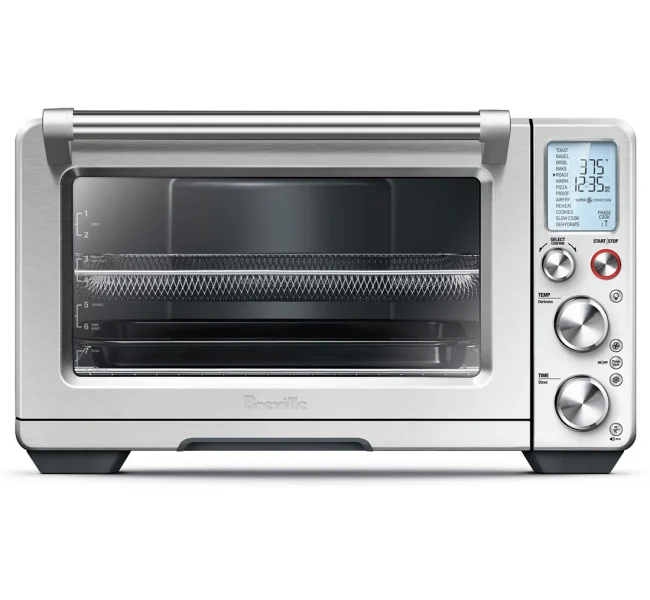
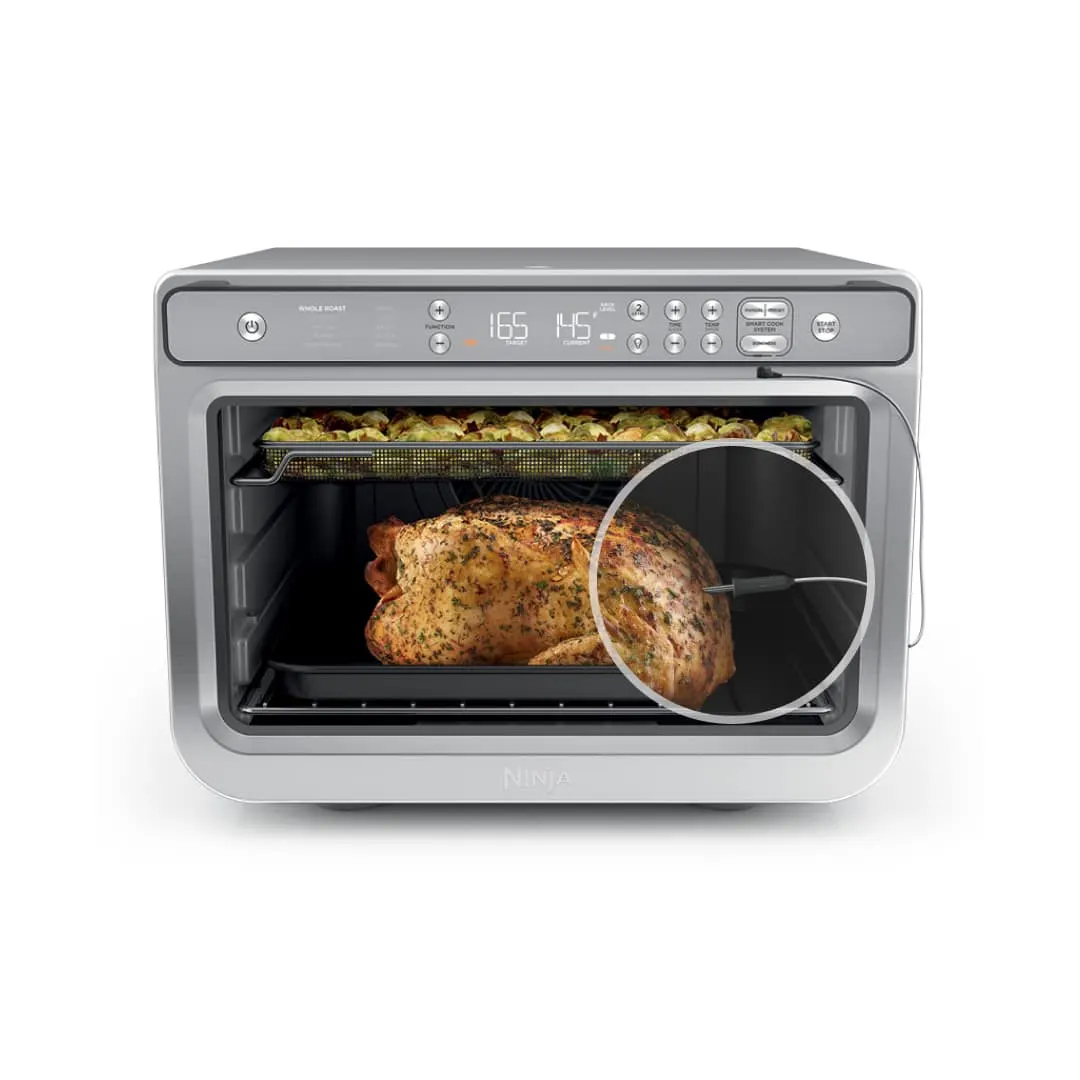
| Model | Wattage, as published | Draw at 120 V | Price (store + read date) |
|---|---|---|---|
| Breville Smart Oven Air Fryer Pro (BOV900BSSUSC) | 1,800 W (breville.com US) | 15 A — the full 15-amp circuit | $319.95 at Target, read Oct 7, 2026 (also $399.95 at Macy’s, Oct 7) |
| Ninja Prestige Smart XL (DT551) | 1,800 W (sharkninja.com) | 15 A — the full 15-amp circuit | $229.99 at SharkNinja, read Oct 7, 2026 |
| Panasonic FlashXpress (NB-G110P-K) | 1,300 W (Panasonic store) | 10.8 A — leaves ~4 A of headroom on a 15-amp circuit | $149.99 at Best Buy (Panasonic marketplace), read Oct 7, 2026) |
| BLACK+DECKER Crisp ‘N Bake Air Fry (TO1787SS) | Not published on the opened pages | Cannot be computed — no wattage published | $71.99 at Target, read Oct 7, 2026 |
| COSORI Smart Air Fryer Toaster Oven 30L (CS130-AO) | Not published on the opened page | Cannot be computed — no wattage published | $149.99 at COSORI (direct), read Oct 7, 2026 |
Reading note: the amps column is plain division of the published wattage by 120 V — no estimated specs involved. “Not published” means exactly that: the pages we opened didn’t state the wattage, so the draw can’t be computed, and we won’t borrow a figure from a marketplace spec table. Note the pattern: the two 1,800 W flagships sit exactly at the 15-amp ceiling, while the Panasonic’s published 1,300 W is the only number here that leaves headroom on a 15-amp circuit. (Ninja’s Foodi XL Pro Air Oven also states 1,800 W on its opened spec page, but we couldn’t read both an exact price and a model number on the same page, so it stays unranked until we can.)
The two-appliances problem (worked example)
This is the breaker trip that actually happens. Take a 15-amp circuit — 1,800 W of total allowance — and run two published-1,800 W ovens on it:
- Breville BOV900 at full power: 1,800 W ÷ 120 V = 15 A
- Ninja DT551 at full power: 1,800 W ÷ 120 V = 15 A
- Combined on one circuit: 30 A against a 15-amp breaker — it trips. On a 20-amp circuit (2,400 W) the same pair draws 30 A against a 20-amp breaker — it also trips.
Swap in the Panasonic’s published 1,300 W: 1,300 + 1,800 = 3,100 W, or about 25.8 A — still over a 20-amp circuit. The honest rule for a 15-amp kitchen is one big countertop appliance at full power per circuit, period. Two smaller draws can coexist only if the wattages add up under the breaker’s limit, which means you need both brands’ published wattages — and two of the five models above don’t publish one, so for them you cannot do this math at all.
Why the brands all land on 1,800 W
It’s the ceiling, and they design to it. A 15-amp, 120 V circuit tops out at 1,800 W, so a manufacturer that wants maximum heating power on every American kitchen counter rates the element at exactly 1,800 W — no one gains anything by rating at 1,700 W and losing 100 W of headroom, and rating higher would trip 15-amp breakers. That’s why the 1,800 W figure repeats across brands and categories: it’s the engineering answer to the most common circuit in the country, not a coincidence. The Panasonic’s 1,300 W is the deliberate opposite bet: a compact infrared oven that trades peak power for instant heat and breaker headroom, aimed at small kitchens rather than big batches.
Verdicts by case
- You trip the breaker when the oven preheats: check the circuit first, not the oven. If the circuit is 15 amps and something else shares it, move the something else. Among our models, the Panasonic FlashXpress (NB-G110P-K) — $149.99 at Best Buy, read Oct 7, 2026 — is the only verified pick under 1,500 W: its published 1,300 W draws ~10.8 A, leaving headroom that a 1,800 W oven can’t give you.
- You want the big 9-slice ovens: the Breville Smart Oven Air Fryer Pro — $319.95 at Target, read Oct 7, 2026 — and the Ninja Prestige Smart XL — $229.99 at SharkNinja, read Oct 7, 2026. Both publish 1,800 W, both draw the full 15 amps, and both belong on a circuit with nothing else running. Honest trade: neither leaves any headroom on a 15-amp circuit.
- You cook with two big appliances at once: stagger them, or put them on different circuits. No pair of our verified 1,800 W models can run together on one 15-amp — or even one 20-amp — circuit. This is also where “not published” hurts: with the BLACK+DECKER and COSORI wattages unpublished, you cannot even compute whether a pair fits.
- You don’t know your circuit’s rating: run one big appliance at a time and call it a day. If your kitchen has a dedicated 20-amp small-appliance branch, the 1,800 W ovens fit comfortably with 600 W of headroom to spare.
Check the Breville Smart Oven Air Fryer Pro on Amazon
Check the Ninja Prestige Smart XL on Amazon
How we compared
Wattage figures come from opened manufacturer pages (breville.com US, sharkninja.com, Panasonic’s store) and pages the guide catalog read; prices are our own dated reads on opened retailer pages (Target, SharkNinja, Best Buy, COSORI direct — all Oct 7, 2026). The amps figures are arithmetic on published wattage at 120 V — not measurements, not estimates. Where a brand didn’t publish wattage, the table says “not published” rather than borrowing a figure from an Amazon spec table. Amazon links appear only for models whose ASINs we confirmed against the exact model number: B01N5UPTZS (BOV900BSSUSC), B0D4R7DMYN (DT551).
Next step: see the ranked picks in our best toaster ovens guide, measure your spot before ordering with how to measure your counter for a toaster oven, read toaster oven vs air fryer if you’re still choosing the appliance type, or Breville vs Ninja toaster ovens for the element-tech comparison of the two 1,800 W flagships.