
Disclosure: As an Amazon Associate, The Counter Lab earns from qualifying purchases made through links on this page, at no extra cost to you. Prices below are the prices we read on November 21, 2026, and they can change.
Hamilton Beach All-Metal Stand Mixer 63227N vs Dash Everyday Stand Mixer DCSM250
The bank note for this topic printed $279.99 for the Hamilton Beach All-Metal Stand Mixer 63227N and $69.99 for the Dash Everyday Stand Mixer DCSM250, from October 10, 2026. On November 21, 2026, the Hamilton Beach lists $279.99 on the Hamilton Beach brand page and the Dash lists $69.99 on the Dash brand page, so both prices are unchanged to the cent from the October 10 reads and the gap today is $210.00 on our subtraction. Both machines are tilt-heads, and they split on almost everything else: the Hamilton Beach prints 400 watts, 12 speeds, 59-point planetary mixing, and an all-metal housing with all-metal gears, while the Dash prints 250 watts, 6 speeds, two beaters on two shafts, and a bowl that locks onto a rotating plate. The Hamilton Beach bowl holds 4.5 quarts and the Dash bowl holds 3 quarts. The Hamilton Beach weighs 15.34 pounds on the retailer figures and the Dash weighs 4.7 pounds on the brand page, a gap of 10.64 pounds. We bought neither machine and tested neither one. Everything below comes from the two brand pages, the Hamilton Beach use and care guide 840142501, the Dash DCSM250 instruction manual, and a Newegg listing for the three Hamilton Beach figures the brand page does not print, all opened or read on November 21, 2026, plus our verified files for the October 10, 2026 reads.
The two machines, on published figures

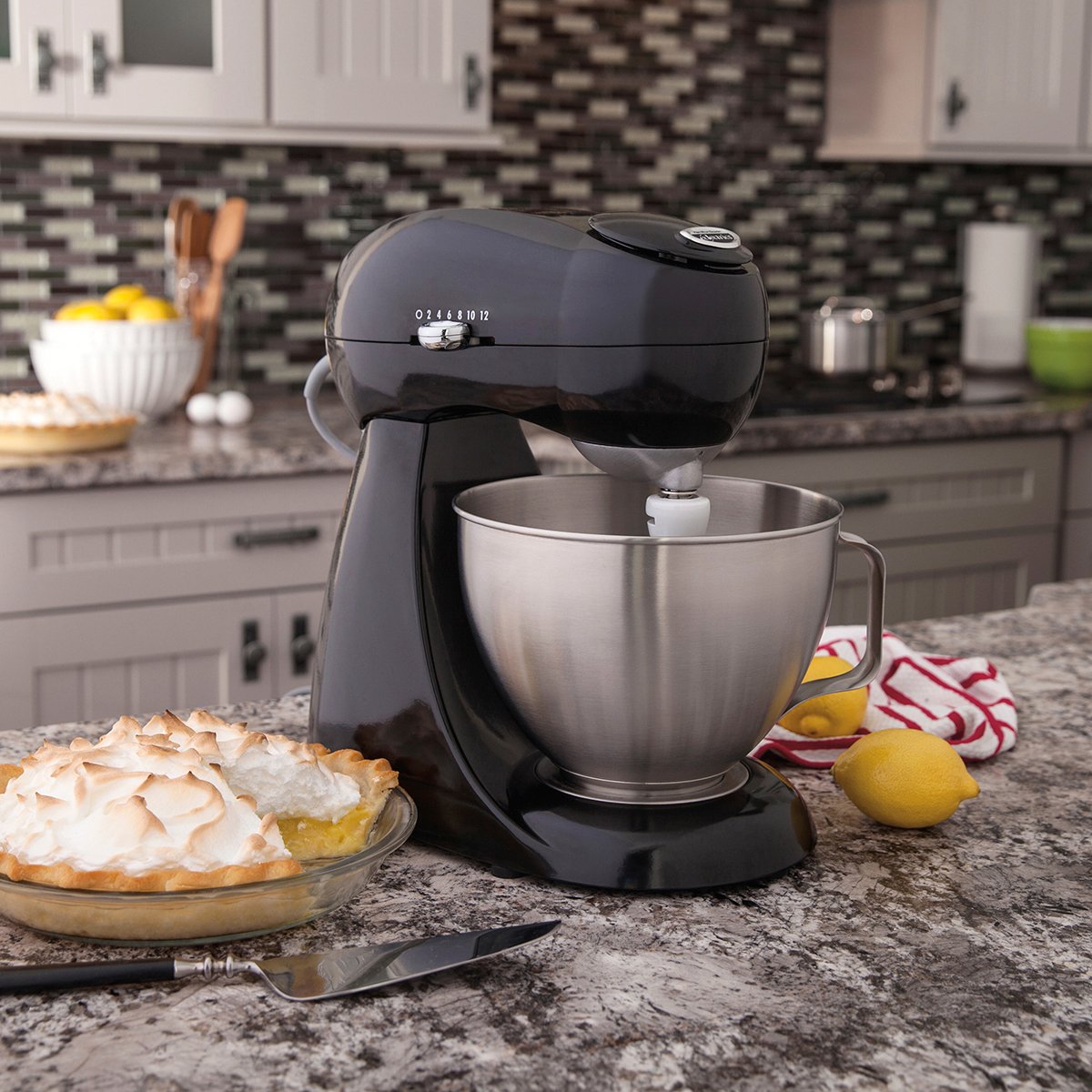


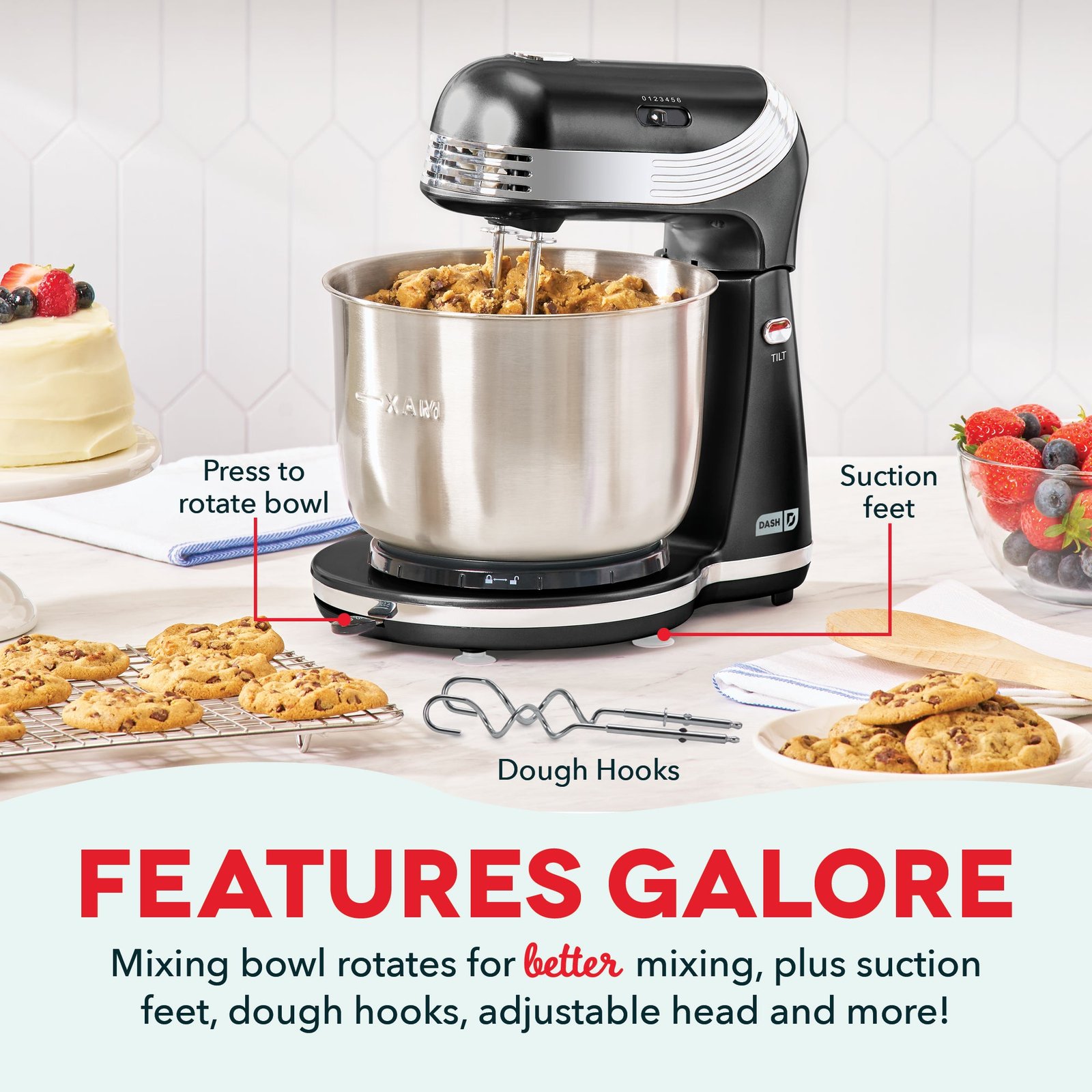
| 63227N | DCSM250 | |
|---|---|---|
| Price today | $279.99 | $69.99 |
| Regular price | None printed | None printed |
| Discount today | None printed | None printed |
| Stock today | In Stock (brand page) | Page prints Sold out at the top; the variant table lists all five colors Available (conflict disclosed below) |
| Bowl capacity | 4.5 qt | 3 qt |
| Batch capacity | Dough for 8 dozen cookies, or a double batch of 4 loaves of bread at 0.75 lb each (brand page) | No batch figure printed |
| Design | Tilt-head, quick-release tilt-up head, 59-point planetary mixing | Tilt-head, tilt release button, two beaters on two shafts, bowl locks onto a rotating plate |
| Power | 400 W | 250 W (manual technical specifications) |
| Speeds | 12 (dial 0 to 12) | 6 (slider 0 to 6) |
| Voltage | 120 V (Newegg) | 120 V, 60 Hz (manual) |
| Bowl | Stainless steel, with handle | Stainless steel |
| Included tools | Flat beater, whisk, dough hook, two-piece pour shield | 2 beaters, 2 dough hooks, recipe guide |
| Attachment hub | None printed | None printed |
| Dimensions | 16.65 in D x 7.01 in W x 14.21 in H (Newegg) | 10.4 in x 8.0 in x 11.5 in (brand page; brand graphic prints 10.5 in height) |
| Footprint, from dims | 116.72 sq in | 83.20 sq in |
| Outside volume, from dims | 1,658.54 cu in | 956.80 cu in |
| Weight | 15.34 lb (Newegg) | 4.7 lb (brand page; a manual-mirror spec table prints 2.65 lb) |
| Cord | Not published | Not published (manual: short cord, no length) |
| Warranty | 1-year limited (brand page; the older manual prints 3-year) | 1-year manufacturer warranty; 2-year warranty available with registration to the Feel Good Rewards program |
| Dishwasher-safe parts | Bowl, pouring shield, and attachments (manual); head and base wipe clean | Mixing bowl and beaters (manual); main base not dishwasher safe |
| Run limit | None printed | Do not use on any setting for more than 10 minutes at a time (manual) |
| Country of manufacture | Not published on the brand page | China (manual) |
| Reviews | None printed on the brand page | 4.6 out of 5 stars, 319 reviews (brand page) |
The price read: $279.99 against $69.99, and a stock line that disagrees with itself
The Hamilton Beach lists $279.99 on the Hamilton Beach brand page on the November 21, 2026 read, in stock, unchanged to the cent from the October 10, 2026 read. The Dash lists $69.99 on the Dash brand page on the November 21, 2026 read, unchanged to the cent from the October 10, 2026 read. The gap today is $210.00, which is 300.0% more than the Dash price and 75.0% of the Hamilton Beach price. The Dash costs 25.0% of the Hamilton Beach price on our division. Neither page prints a regular or list price, so no discount figure is printed for either machine. The Dash stock line is the one figure in this post that disagrees with itself: the page prints Sold out at the top, beside the $69.99 price, and the variant table on the same page lists all five colors, Black, Aqua, Pink, Red, and White, as Available at $69.99 each. This post states the conflict and claims no firm stock state for the Dash, since the page alone does not settle it. A buyer who wants the Dash should check the color they want before ordering, and a buyer who wants the Hamilton Beach can order from the brand page at the printed price.
Two tilt-heads, two different mixing actions
Both machines tilt the head up to change tools and remove the bowl, and the two designs get there in different ways. The Hamilton Beach uses a quick-release tilt-up head: the manual says to press up on the Mixer Release Button and tilt the head up, and the head locks in the upright position and locks down for mixing. The beater turns on its own axis while it orbits the bowl, in the 59-point planetary action the brand page prints, which the page describes as 59 touchpoints around the bowl. The Dash uses a tilt release button on the side of the stand, marked TILT, and the head pushes up by hand. It mixes with two beaters on two shafts, left and right, and the manual says the left and right beaters must go into the matching shafts. The bowl locks onto a rotating plate on the base, and a bowl shift lever turns the bowl to move dough off the sides. The Dash ships 2 beaters and 2 dough hooks, and the manual says the beaters and dough hooks must not be used together. The Hamilton Beach ships a flat beater, a whisk, a dough hook, and a two-piece pour shield. The Hamilton Beach bowl holds 4.5 quarts with a handle, and the Dash bowl holds 3 quarts with no handle printed. The Hamilton Beach prints a batch claim the Dash does not: dough for 8 dozen cookies, or a double batch of 4 loaves of bread at 0.75 pounds each, in a single batch. The Dash manual prints the opposite kind of limit: the mixer works best with small batches, it should only mix soft ingredients such as flour, cream, eggs, or creamy liquids, and a buyer should not try to mix hard ingredients. Neither machine prints an attachment hub, so neither post claims one.
Power: 400 watts against 250 watts, on the printed figures
The Hamilton Beach prints 400 watts on the brand page, at 12 speeds on a dial numbered 0 to 12. The Dash prints 250 watts in the technical specifications of the official manual, at 120 volts and 60 hertz, with 6 speeds on a slider numbered 0 to 6. The gap is 150 watts, which is 60.0% more than the Dash figure and 37.5% of the Hamilton Beach figure. Per quart of bowl, the Hamilton Beach prints 88.89 watts and the Dash prints 83.33 watts, a gap of 5.56 watts per quart, so the wattage gap follows the bowl gap and the two machines print nearly the same watts per quart. Per dollar, the Hamilton Beach costs $0.7000 per watt and the Dash costs $0.2800 per watt, a gap of $0.4200, so the same dollar buys more watts on the Dash side. The Hamilton Beach prints twice as many speeds as the Dash. The Dash manual prints one limit the Hamilton Beach page does not: do not use the mixer on any setting for more than 10 minutes at a time, since the motor may overheat, and allow the motor to cool between uses. Neither page prints torque or a load rating, so the wattage gap says the Hamilton Beach draws more power at full load, and it says nothing by itself about how either machine handles a stiff dough.
Size, weight, and the numbers that disagree
The Hamilton Beach brand page does not print dimensions, weight, or voltage, so those three figures come from Newegg, a retailer listing, and the table names the source. Newegg prints 16.65 inches deep by 7.01 inches wide by 14.21 inches high, and 15.34 pounds, with a 120-volt input. That gives a footprint of 116.72 square inches and an outside volume of 1,658.54 cubic inches on our multiplication. The Dash brand page prints 10.4 by 8.0 by 11.5 inches and 4.7 pounds, which gives a footprint of 83.20 square inches and an outside volume of 956.80 cubic inches. The Hamilton Beach footprint is 33.52 square inches larger, or 40.3% more than the Dash footprint, and its outside volume is 701.74 cubic inches larger, or 73.3% more than the Dash volume. The Hamilton Beach is 2.71 inches taller, or 23.6% taller than the Dash. The weight split is the widest gap in the table: the Hamilton Beach prints 15.34 pounds and the Dash prints 4.7 pounds, a gap of 10.64 pounds, which is 226.4% heavier than the Dash figure, and the Dash weighs 30.6% of the Hamilton Beach weight. Three numbers disagree across the pages opened, and the table prints the conflicts rather than picking a side. The Dash brand graphic prints a height of 10.5 inches against the brand page figure of 10.4 inches, a 0.1-inch rounding gap, and the table follows the page. A manual-mirror spec table prints 2.65 pounds for the Dash against the brand page figure of 4.7 pounds and the brand graphic claim of under 5 pounds, and the table follows the brand page. The Hamilton Beach warranty prints two ways: the current brand page prints a 1-year limited warranty, and the older use and care guide prints a 3-year warranty, and the table follows the brand page. The Dash warranty prints one way on the brand page, a 1-year manufacturer warranty, with a 2-year warranty available on registration to the Feel Good Rewards program. The Dash manual prints that the mixing bowl and beaters are dishwasher safe and the main base is not, and the Hamilton Beach manual prints that the bowl, pouring shield, and attachments can go in a dishwasher, with the head and base wiped clean.
The case for each machine
The Hamilton Beach fits a buyer who wants the bigger bowl, the metal build, and the planetary action. It prints a 4.5-quart bowl with a handle, 400 watts, 12 speeds, a batch claim of 8 dozen cookies, and a pour shield in the box, and it is in stock on the brand page at $279.99. Its limits are printed too: it weighs 15.34 pounds, it costs $210.00 more than the Dash, and the brand page prints no dimensions, weight, or voltage, so those figures come from a retailer listing. The Dash fits a buyer who wants the lightest, smallest, and cheapest tilt-head in this pair. It prints a 3-quart bowl, 250 watts, 6 speeds, a rotating bowl plate, suction feet, and a weight of 4.7 pounds, at $69.99 in five colors. Its limits are printed too: the page prints Sold out at the top while the variant table lists every color Available, the manual limits each run to 10 minutes and soft ingredients only, and it prints no batch claim. If the metal build, the bigger bowl, and the batch claim are the deciding factors, the Hamilton Beach is the pick on the printed figures. If the price and the weight are the deciding factors, the Dash is the pick on the printed figures, and the buyer should check the stock of the color they want first, since the page disagrees with itself.
Where to go next
Our best stand mixers guide ranks the stand mixers we track, and the stand mixers hub holds the full set. For bowl sizes and wattage claims as a class, read stand mixer bowls and wattage decoded. For the KitchenAid pair at a higher price point, read KitchenAid Artisan vs Professional 600. For the budget tier, read best stand mixers under $200. For the smaller tilt-head pair, read KitchenAid Artisan Mini vs Classic. For the other premium non-KitchenAid pair, read Bosch Universal Plus vs Ankarsrum Assistent.
How we compared
We compared only figures printed on pages opened or read on November 21, 2026: the Hamilton Beach brand page for the 63227N, the Newegg listing for the three Hamilton Beach figures the brand page does not print, the Hamilton Beach use and care guide 840142501 for the tilt-head steps, the dishwasher wording, and the older warranty figure, the Dash brand page for the DCSM250, and the Dash DCSM250 instruction manual for the 250-watt rating, the voltage, the tilt-head steps, the dishwasher wording, the 10-minute run limit, and the country of manufacture, plus our verified files for the October 10, 2026 reads. No figure is converted between units that the pages do not convert, and no figure is borrowed from a sibling model: the Hamilton Beach gallery insets for the red 63232 and the sugar 63221 were not used, and only the two black 63227N images went into the photo row. Four limits are printed, not hidden: the Dash page prints Sold out at the top while its variant table lists all five colors Available, so this post claims no firm Dash stock state; the Hamilton Beach dimensions, weight, and voltage come from a retailer listing because the brand page does not print them; the Dash weight prints 2.65 pounds in a manual-mirror spec table against 4.7 pounds on the brand page, and the table follows the brand page; and the Hamilton Beach warranty prints 1-year limited on the current brand page against 3-year in the older manual, and the table follows the brand page. This pair is distinct from our earlier posts: the Hamilton Beach 63325 vs 63390 post compares two Hamilton Beach models against each other, the under-$200 slice covers the budget tier as a class, the bowls and wattage post explains sizes and claims as a class, the Artisan vs Professional 600 post compares two KitchenAid models, and no earlier live post compares the Hamilton Beach 63227N against the Dash DCSM250 directly.
Amazon links in this post go only to model-confirmed listings. Neither machine carries a buy button, since no model-confirmed ASIN exists for either model in our files. We bought neither machine and tested neither one. If a price or a spec changes after November 21, 2026, the figures above are the ones we read that day.