
Beast B10 vs Cleanblend Classic: 1,000 W against 1,800 W, on published specs
As an Amazon Associate, The Counter Lab earns from qualifying purchases. We don’t do hands-on testing and we don’t accept free units. Every figure below is a number a brand published on a page we opened ourselves. When a page didn’t publish a figure, the table says so, and we never borrow a claim from a review site or a marketplace spec table.
Beast’s B10 Health Blender sells for $123.00 and prints 1,000 watts on its page. It prints no horsepower figure at all. The Cleanblend Blender Classic sells for $179.99 and prints 1,800 watts and 3 HP. One brand refuses the HP game; the other leads with it. The difference between those claims is the whole subject of this post: what each maker puts in writing about power, and what the watts and HP numbers on the two boxes actually let you compare. A third row, Beast’s own Mega 1200 at $184.00, shows that even inside one brand the two units don’t line up.
The three machines on published figures



| Model | Price read | Motor (watts) | HP claim | Vessel | Controls | Warranty |
|---|---|---|---|---|---|---|
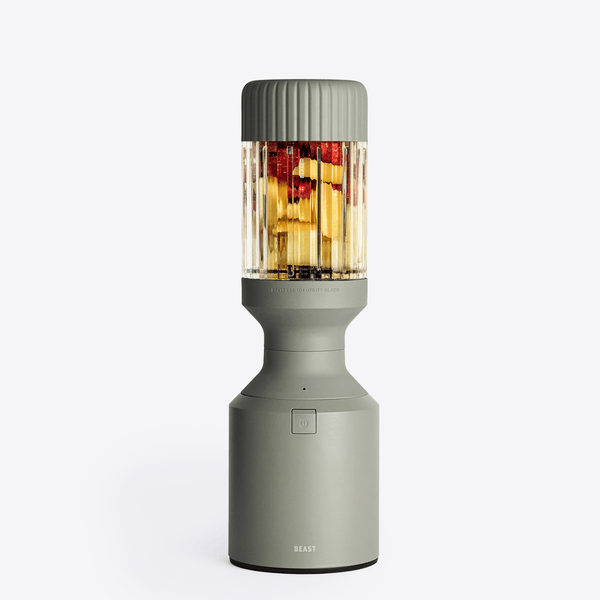
| Beast B10 Health Blender | $123.00 at Beast (thebeast.com), InStock, read Oct 23, 2026 | 1000 W (“1000-watt motor, tuned for maximum performance”) | not published (no HP figure on the brand page) | 1000 mL Tritan blending vessel, 12-rib design (ounces not stated) | timed one-minute blend cycle + pulse | not published |
| Cleanblend Blender Classic | $179.99 at Cleanblend (cleanblend.com), InStock, read Oct 23, 2026 | 1800 W | 3 HP | 64 oz BPA-free container, 8-blade food-grade stainless steel system | variable speed + pulse; BPA-free tamper included | 5 years |
| Beast Mega 1200 Blender | $184.00 at Beast (thebeast.com), InStock, read Oct 23, 2026 | 1200 W | “equivalent of 1.6 horsepower” (the brand’s own wording) | 1000 mL / 34 oz Tritan vessel in the base configuration | one-button timed blend cycle | 2 years, limited |
What the Beast rows tell you about watt claims
Beast is the honest witness in this comparison, because it disagrees with itself. The B10 page prints 1000 watts and no horsepower figure. The Mega 1200 page prints 1200 watts and “the equivalent of 1.6 horsepower,” the brand’s words, not ours, and not a peak-HP label. The gap between those two choices is the point. Watts measure electrical input. Horsepower, when a brand prints it, is a rated output claim, and brands rate it however they rate it. Beast’s own pages show there is no single watts-to-HP formula: the B10 doesn’t play, and the Mega translates 1200 watts into 1.6 of something with the softening word “equivalent” in front.
The B10 row has more to offer than a motor figure. The brand prints a 1000 mL vessel with a 12-rib interior it says makes the blend smoother, grade 301 stainless steel blades, and a timed one-minute blend cycle with pulse. It also says the motor watches blade speed and makes rapid adjustments to hold it steady. That is a published performance mechanism, not a number: instead of claiming more power, Beast claims smarter power. The price we read on Oct 23, 2026 was $123.00, in stock on Beast’s own store. The page does not publish a warranty term, so we don’t either.
What the Cleanblend row tells you about HP claims
Cleanblend is the loud witness. The brand page prints 3 HP and 1800 watts, the biggest motor figures in this comparison, beside a 64 oz BPA-free container and an 8-blade food-grade stainless steel system with a sealed ball bearing. The control set is the classic high-speed formula: variable speed, pulse, and a BPA-free tamper for thick blends. The warranty is 5 years, the longest term here. The price we read on Oct 23, 2026 was $179.99, in stock on Cleanblend’s own store.
The 1800-watt figure deserves a separate look because it sits next to the 3 HP figure. Our catalog holds a second 3-HP claim: the Blendtec Designer 650 S, whose maker publishes 1560 watts and 3 HP, confirmed on Blendtec’s US page and a Williams Sonoma listing we opened. Two brands, two watt figures, one HP label. That is not a contradiction to resolve; it is the evidence that HP labels are not a common yardstick. Cleanblend’s 3 HP and Blendtec’s 3 HP are rated under different rules by different makers. Our general decoder on why the numbers on the box don’t compare walks through this in full.
Cleanblend also prints a 120 V plug alongside the 1800-watt motor. We didn’t compute the circuit draw ourselves; our kitchen-circuit post walks through what a 1,800-watt appliance asks of the outlet, and it is worth reading before the watts number does its marketing work.
Pros and cons, from the spec sheets
Beast B10. Pros: the lowest price in the comparison at $123.00; the timed one-minute cycle plus pulse is the simplest control set here; the 12-rib vessel and blade-speed monitoring are documented design choices rather than a bigger motor claim; dishwasher-safe vessels and parts on the top rack. Cons: no published warranty term; the 1000 mL vessel is the smallest of the three; 1000 watts is the smallest motor print; Beast’s store sells the Mega 1200 with more headroom for $61 more.
Cleanblend Classic. Pros: the biggest published motor figures here, 1800 W and 3 HP; the 64 oz container is the largest vessel; the 5-year warranty is the longest term; variable speed plus pulse plus a tamper covers thick blends on paper. Cons: $179.99 is $56.99 more than the B10; the 1800-watt draw deserves a circuit check; the page claims a Wirecutter 2025 best-blender pick, which is the brand’s citation, not our verification; Cleanblend publishes no model number on the page, so matching parts or manuals later is harder.
Beast Mega 1200. Pros: 1200 watts with the brand’s own 1.6-HP equivalent note; a real 2-year limited warranty in writing; the base box ships a 1000 mL / 34 oz vessel and the brand sells bigger vessels separately; six color options. Cons: $184.00 is the highest price here, $5.01 above the Cleanblend; the “equivalent” HP wording is the brand hedging its own claim; the XL 40 oz vessel costs the Plus configuration, not the base.
Per-case verdicts
Buy the $123.00 Beast B10 if you want the cheapest way to blend daily smoothies and you trust a timed cycle over a watt number. It is the only machine here whose maker refuses the HP game entirely and prints the design story instead: ribbed vessel, timed cycle, blade-speed monitoring. The price is $56.99 under the Cleanblend and $61 under the Mega 1200. What you give up is a warranty term in writing and the headroom of a bigger motor.
Buy the $179.99 Cleanblend Classic if you want the biggest published motor figures and the longest warranty at the lowest price that buys both. The 1800 W / 3 HP print and the 5-year term are the strongest paper in the comparison. The 64 oz container suits batch blends the 1000 mL Beasts can’t match. The honest cost of the win: the HP label is rated on Cleanblend’s terms, not yours, and Blendtec’s 1560 W / 3 HP print proves the label isn’t portable across brands. Judge it by the watts and the warranty, not the 3 HP.
Buy the $184.00 Beast Mega 1200 if you want Beast’s design language with more motor and a warranty in writing. The 1200 W / 1.6-HP-equivalent print is the middle motor of the three, and the 2-year limited warranty is real coverage the B10’s page doesn’t publish. You pay $5.01 more than the Cleanblend for a smaller motor print and a smaller warranty, which makes the Mega the design-first pick in this comparison, not the value-first one.
How we compared
We opened the three brand product pages ourselves on Oct 23, 2026 and read every figure in the table from them. Beast’s pages are at thebeast.com; Cleanblend’s is at cleanblend.com. When a page didn’t publish a figure (Cleanblend’s model number, Beast B10’s warranty), the table says “not published” and the prose doesn’t guess. We did not convert watts to horsepower or the reverse ourselves; where a brand printed both, we printed both, and where it printed one, the other cell says “not published.” The Blendtec 1560 W / 3 HP figure is from our own verified catalog reads of Blendtec’s US page and a Williams Sonoma listing, not from a search snippet. Prices are the exact amounts on the pages at read time; none came from Amazon, and none of these three models carries a model-confirmed Amazon ASIN, so this post has no buy buttons.
Want the general version of this argument: why watts and horsepower are not the same yardstick, plus the tie-breakers we use when two spec sheets tie? Our blender spec-sheet decoder and the watts-vs-horsepower post are the next two reads. The full blender lineup, with dated prices on every model we track, is on the blender hub.