
Disclosure: The Counter Lab earns a commission on purchases made through links on this page, at no extra cost to you. Prices below name the retailer and the date they were read.
Cuisinart Coffee on Demand vs Keurig K-Duo Hot and Iced: dispenser against pod plus carafe
Cuisinart and Keurig answer the same household question in opposite ways. The Cuisinart Coffee on Demand (DCC-3000) brews one full pot and stores it in an internal reservoir, then dispenses one cup at a time from a lever. The Keurig K-Duo Hot and Iced brews either a single K-Cup pod or a full carafe of ground coffee, from one shared 72 oz water reservoir. One machine removes the carafe. The other removes the choice between a pod machine and a drip machine. The prices read on Oct 10, 2026 sit $10 apart: $149.99 for the Cuisinart at Target, $139.99 for the Keurig at Target. One fact changes the purchase before any spec does: Cuisinart lists the DCC-3000 as discontinued on its own site, so remaining stock is what is left at retailers, not a current line.
The two machines on published figures
| Figure | Cuisinart Coffee on Demand 12-Cup (DCC-3000) | Keurig K-Duo Hot and Iced |
|---|---|---|
| Brew method | Ground coffee only, brewed as one pot | K-Cup pods for single cups, ground coffee for the carafe |
| Vessel | No carafe; double-wall internal coffee reservoir with a dispenser lever | Glass carafe for the carafe side; mug under the pod side |
| Capacity, as published | 12 cups, defined on the brand page as twelve 5 oz cups (60 oz) | Carafe in 6, 8, 10, and 12 cups; single cups in 6, 8, 10, and 12 oz |
| Water reservoir | Removable water reservoir; volume not published on the brand page | 72 oz removable water reservoir, shared by both sides |
| Programming | 24-hour advance brew start, programmable auto shutoff, 1 to 4 cup setting | Programmable Auto Brew up to 24 hours in advance for the carafe side |
| Keep-warm method | Double-wall coffee reservoir; no plate, no carafe to sit on heat | Heating plate under the glass carafe; the manual says the plate stays on for 2 hours after a carafe brew |
| Single-serve controls | Not a pod machine; the lever dispenses from the brewed pot | Brew Over Ice (single serve only), Strong Brew, Extra Hot, MultiStream Technology |
| Filters | Permanent gold-tone basket filter, charcoal water filter | Paper filter and grounds on the carafe side, per the manual |
| Cleaning | Self-clean setting; removable coffee reservoir and removable drip tray | Pause and Pour on the carafe side; the manual warns that removing the carafe for more than 20 seconds may cause the filter basket to overflow |
| Coffee gauge | Yes; the gauge counts down cups remaining in the reservoir | No gauge; the shared reservoir level is visible on the machine |
| Warranty | Limited 3-year warranty, per the brand page | Not published on the opened brand and manual pages |
| Wattage | Not published on the brand page | Not published on the opened brand and manual pages |
| Dimensions and weight | 14.7 x 8.75 x 11.25 in and 11.5 lb; dimensions from an Abt retailer listing, weight from the brand page | Not published on the opened brand pages |
| Status | Discontinued on the brand site, shown out of stock there | Current line on the brand site |
| Price | $149.99 at Target, read Oct 10, 2026 | $139.99 (list $189.99) at Target, read Oct 10, 2026 |
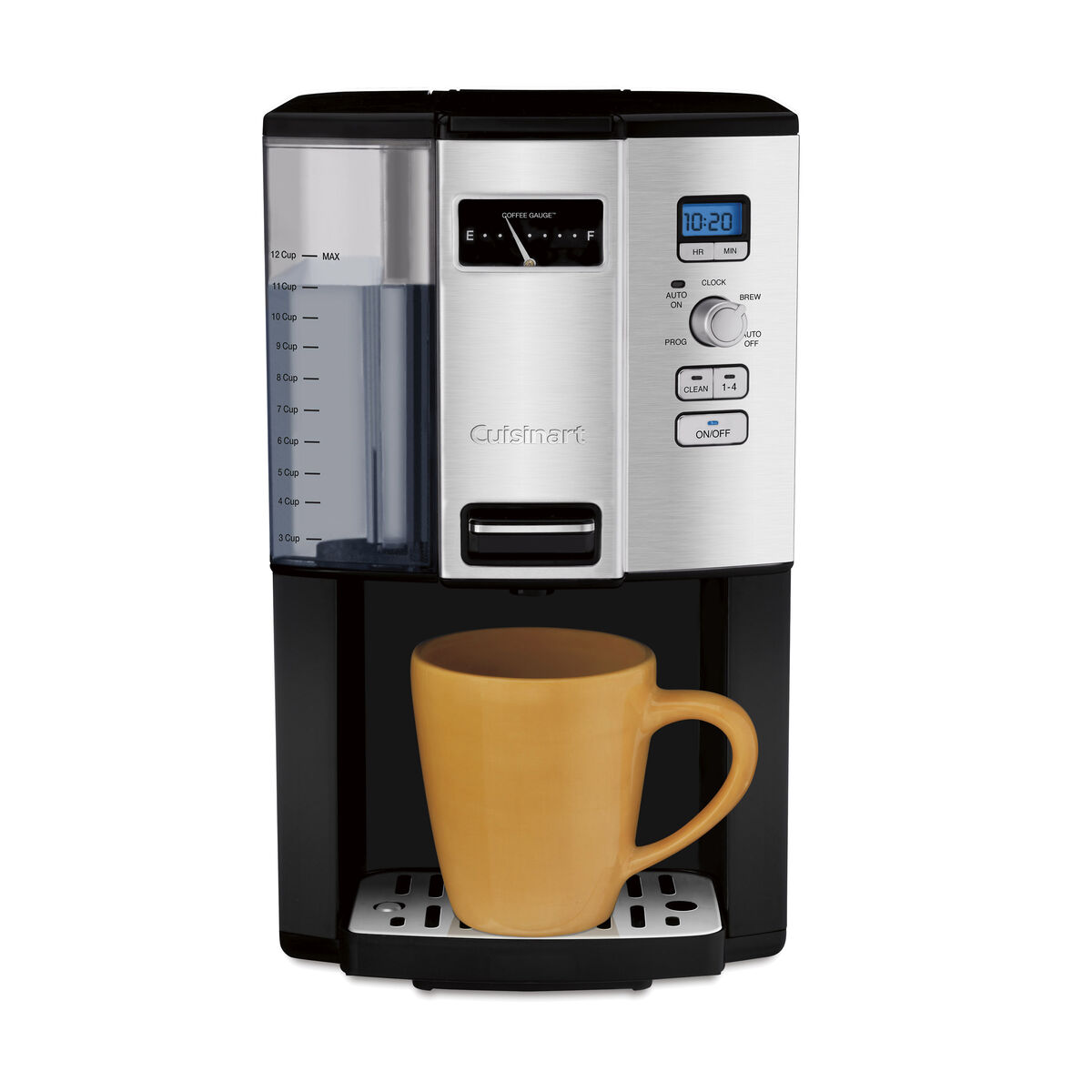
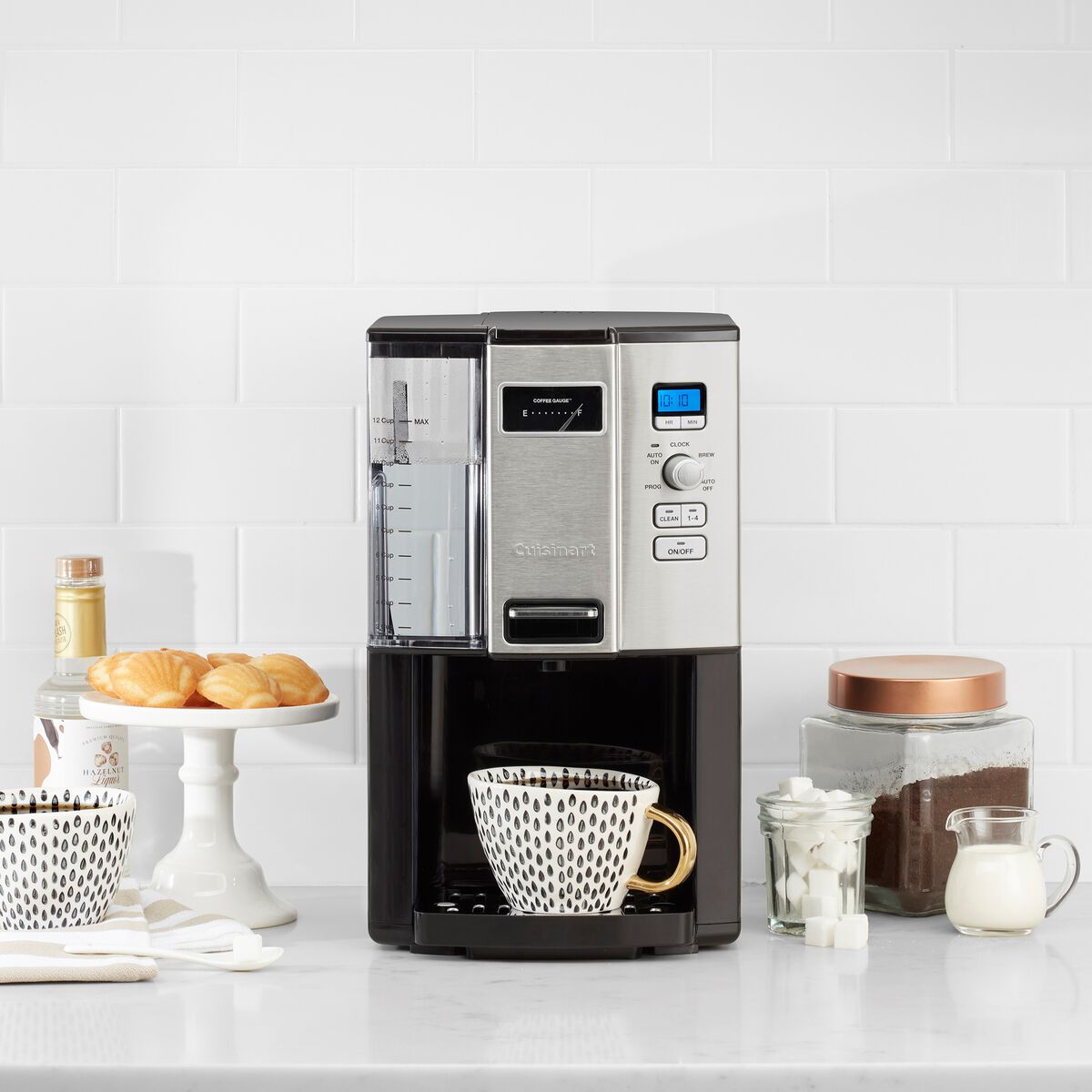


Dispenser against pod plus carafe
The Cuisinart brews once and serves many times. A household that drinks at staggered hours gets one pot in the morning and a lever pull per cup after that, with no second brew and no carafe to pour from. The cost of that design is choice: every cup comes from the same pot, so a second drinker who wants a different roast or a decaf waits for the next pot. The gauge answers the one question this design creates, which is how much is left, by counting down cups remaining.
The Keurig brews per occasion. A single drinker uses a pod in 6, 8, 10, or 12 oz. A group uses grounds in a carafe in 6, 8, 10, or 12 cups. The shared 72 oz reservoir means neither side needs its own fill, and the Brew Over Ice, Strong Brew, and Extra Hot controls apply to the single-serve side only. The cost of that design is running cost and parts: pods for single cups, paper filters and grounds for carafe brews, and two brew paths to descale and maintain.
Capacity needs a careful read on both sides. Cuisinart defines its cup at 5 oz, so its 12 cups are 60 oz of brewed coffee. Keurig prints single-serve sizes in ounces but prints carafe sizes in cups with no ounce definition on the opened pages, so the two 12-cup figures are not the same unit. The price math on stated cups is $149.99 divided by 12, or $12.50 per stated cup, against $139.99 divided by 12, or $11.67 per stated cup. That math is ours, on stated cups only, and it does not settle which machine serves more coffee, because the cup definitions differ.
The discontinued label on the Cuisinart
Cuisinart’s own discontinued listing for the DCC-3000 says the model is discontinued and shows it out of stock on the brand site. Retailers still listed it at the Oct 10, 2026 read, at $149.99 at Target, and the model still appears in retailer listings after that date. A buyer who wants the dispenser design is therefore buying remaining stock, and the 3-year limited warranty on the brand page is the warranty that matters, not a current-line service promise. Check stock before planning around the $149.99 read, and check that the seller is selling the DCC-3000 itself, because Cuisinart sells other 12-cup machines with similar names, including the DCC-3200 PerfecTemp, which is a different machine with a glass carafe.
Keep-warm: reservoir, plate, and the gap in the record
Neither machine keeps coffee warm the way a thermal carafe does. The Cuisinart holds brewed coffee in a double-wall reservoir inside the machine, with no plate under it. The Keurig holds brewed coffee in a glass carafe on a heating plate, and the manual puts a number on that plate: 2 hours after a carafe brew, with a press-and-hold control to switch the plate off. The Cuisinart page gives no hour figure for its reservoir, so this post gives none. A household that drinks a pot across a full workday has a published 2-hour plate figure on one side and an unpublished reservoir figure on the other, and that gap is a reason to favor the Keurig for long sits, or to accept the Cuisinart only for pots that empty within a few hours.
Per-case verdicts
Buy the Cuisinart if staggered drinkers share one pot and the dispenser is the point. The lever, the gauge, and the carafe-free reservoir are a single design for a household that brews once and pours across the morning. Buy it only from stock that is actually available, at or near the $149.99 read, and confirm the model number DCC-3000 before paying.
Buy the Keurig if one machine must serve both a single pod drinker and a full carafe. At $139.99 at Target (read Oct 10, 2026, against a $189.99 list), it is the current line, it brews pods and grounds, and its plate and single-serve controls are published in its own manual. The $10 gap against the Cuisinart is not the reason to pick it; the pod side and the current-line status are.
Skip both if the pot must stay hot for hours without heat applied. Neither machine uses a thermal carafe. Our thermal vs glass carafe decoder covers twelve drip makers that do, and the thermal side of that table starts at $189.99.
How we compared
Every figure above comes from a page we opened: the Cuisinart figures from the brand’s discontinued DCC-3000 listing, with dimensions from an Abt retailer listing where the brand page printed none, and the Keurig figures from Keurig’s own K-Duo pages and the K-Duo use and care guide. Prices are the Oct 10, 2026 catalog reads, stamped with retailer and read date in the table. Where a page printed nothing, the table says so: wattage is not published for either machine on the opened pages, Keurig warranty and dimensions are not published on the opened pages, and the Cuisinart water reservoir volume is not published on the brand page. We did not convert watts, estimate noise, or fill gaps from review sites. No Amazon links appear here because neither model has a model-confirmed ASIN on file for this post.
Next steps
If the question is how much a drip maker should cost at all, our budget vs premium drip maker classes post covers five verified models from $19.99 to $379. If the household is bigger than either machine here, our big-household 12 to 14 cup class puts three 12 to 14 cup brewers side by side. For the full ranked list, see our best coffee makers guide and the coffee maker hub.