
Drip Coffee Makers: What $19.99 and $379 Actually Buy
As an Amazon Associate, The Counter Lab earns from qualifying purchases. We don’t do hands-on testing and we don’t accept free units. Every figure below is a number a brand or retailer published on a page we opened ourselves. When a page didn’t publish a figure, the table says so, and we never borrow a claim from a review site or a marketplace spec table.
Five drip coffee makers we verified for the best coffee makers guide span $19.99 to $379.00, a 19x spread. The ranking answers which machine wins each pick; this post answers a different question: what each price class buys, what it gives up, and where the lines between the classes sit. The cheapest machine here is programmable. The $99.95 row publishes the fullest timer feature list in the table. The most expensive ones are the only ones that publish a wattage. None of that follows the price line in the way you would expect.
The five classes, on published figures


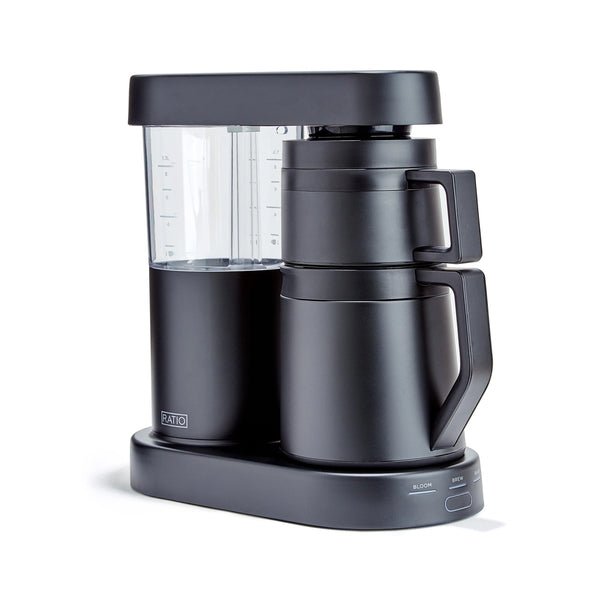
| Class | Model | Price read | Carafe, as published | Wattage | Programmable | Certification |
|---|---|---|---|---|---|---|
| Budget | Hamilton Beach 12-Cup Programmable Black (46290) | $19.99 (list $27.99) at Target, read Oct 10, 2026 | 12 cups, glass | Not published | Yes, plus brew pause | None published |
| Programmable value | Cuisinart PerfecTemp 14-Cup Programmable (DCC-3200) | $99.95 (list $119.95) at Macy’s, read Oct 10, 2026 | 14-cup glass (5 oz/cup) | Not published | 24-hour, brew-strength control, 1-4 cup mode | None published |
| Thermal tier | OXO Brew Thermal 8-Cup (8718800) | $219.95 at Crate & Barrel, read Oct 10, 2026 | 8 cups, thermal vacuum | Not published | Single-serve mode | SCA certified |
| Certified flagship | Technivorm Moccamaster KBGV Select | $369.95 at Williams Sonoma, read Oct 10, 2026 | 1.25 L / 40 oz / 10 cups, glass | 1,475 W | No timer on the published feature list | SCA/ECBC |
| Premium | Ratio Six Series 2 | $379.00 at Seattle Coffee Gear, read Oct 10, 2026 | 40 oz brew / 44 oz reservoir, thermal | 1,400 W | No timer on the published feature list | SCA Gold Cup |
The class labels are ours, drawn around where the table’s features and prices cluster; every cell figure is the maker or retailer’s own wording. Capacity is printed exactly as each brand states it: the Cuisinart defines its cup at 5 oz, the Moccamaster and the Ratio state ounces and liters, the Hamilton Beach and the OXO print cups only. We don’t convert between them.
Programmability runs against the price line
This is the first way the table refuses to follow the price line. The $19.99 Hamilton Beach publishes programmability and brew pause. The $99.95 Cuisinart publishes the fullest timer feature list in the table: 24-hour programming, brew-strength control, and a 1-4 cup mode. The $369.95 Moccamaster and the $379.00 Ratio Six print no timer at all on their published feature lists. If waking up to brewed coffee is the requirement, the money stays at the bottom two rows: paying 19x more buys you the opposite, a machine you switch on by hand.
The carafe is the real class boundary
The second split is keep-warm method, and it cuts the table in the middle. The two budget rows and the Moccamaster keep coffee on a glass carafe sitting over a warming plate, so coffee that waits keeps cooking. The OXO and the Ratio use a thermal vacuum carafe, so coffee holds heat without a plate under it. The thermal line starts at $219.95. Note what sits on either side: the Moccamaster at $369.95 still pairs a glass carafe with its independent hotplate (the half/full selector is a brew-size feature, not a keep-warm one), while the Ratio at $379.00 charges $9.05 more than the Moccamaster for the thermal carafe, the auto-bloom cycle, and capacities stated in ounces instead of maker-defined cups.
Certification and published wattage live at the top
Third, the two things that are hardest to verify from the outside both appear only in the upper rows. Brew certification (SCA, ECBC, SCA Gold Cup) is published on the OXO, the Moccamaster, and the Ratio, and on nothing below $219.95. Published wattage appears on exactly two machines: the Moccamaster at 1,475 W and the Ratio at 1,400 W. Three of the five picks print no wattage on the pages we read, which means there is no honest way to rank motor power across the classes: the $99.95 Cuisinart cannot be set against the $369.95 Moccamaster on power, because only one of the two publishes a figure. Treat any review that prints one as guessing.
Capacity honesty scales with price, roughly
Fourth, the stated-capacity problem shrinks as the price climbs. At the bottom, “12 cups” and “8 cups” mean whatever each maker says, with no ounce definition. In the middle, Cuisinart prints the definition: 5 oz per cup, which makes its 14-cup headline worth about three mugs less than the number suggests. At the top, the Moccamaster and the Ratio state liters and ounces outright: 1.25 L / 40 oz and 40 oz brew / 44 oz reservoir. The premium tier doesn’t just brew more carefully; it measures more carefully.
Per-case verdicts
Buy the $19.99 Hamilton Beach 46290 if the budget is firm and a timer matters. It is the only model-confirmed 12-cup programmable we verified at this price, with the model number on the page so the price ties to an exact machine. The trade is documentation: no published wattage and no capacity definition.
Buy the $219.95 OXO Brew Thermal 8718800 if coffee sits for hours. It is the cheapest certified brewer with a thermal carafe, the only row that avoids the hot-plate problem. The trade is size: 8 cups is the smallest carafe in the table, and wattage is not published.
Buy the $369.95 Moccamaster KBGV Select if certification on published specs is the deciding factor. It carries the most completely verified spec sheet in the table: stated capacity, a published 1,475 W, and SCA/ECBC certification. The trade is programmability: none published, and some finishes on the same page ranged to $389.95.
The $99.95 Cuisinart DCC-3200 is the feature-per-dollar middle: the largest stated capacity and the fullest timer feature list under $100, with no certification and no published wattage. The $379.00 Ratio Six Series 2 is the premium answer to the Moccamaster: the same certification family, a thermal carafe, ounces stated plainly, $9.05 more, and a stock check at read time showed it sold out, so check live availability.
The honest limits of this comparison
Prices were read on live pages on Oct 10, 2026 and are stamped with the retailer that showed them; prices move, so re-check at checkout. No model-confirmed Amazon ASINs exist for any of the five drip coffee makers, so this post carries no buy buttons; when a model-ASIN link is confirmed, it appears here. Wattage is unpublished for three of the five rows, so power cannot be ranked across classes. The Bonavita Connoisseur, the Zwilling Enfinigy, and the BUNN BT Speed Brew were not ranked because their opened pages showed no readable US price; they join the comparison when a price is read. We have no hands-on testing and we don’t accept free units: these machines are compared on published numbers and dated prices, and the class labels are our own reading of the clusters the numbers form.
How we compared
Every spec above comes from a manufacturer or retailer page we opened ourselves, and each brand’s capacity wording is printed exactly as the brand prints it. Prices were read Oct 10, 2026, stamped with the retailer and the read date. Wattage appears only where a page published it for that exact model. The price-multiple math is ours: $379.00 divided by $19.99 is about 19x, and the Ratio Six’s $379.00 minus the Moccamaster’s $369.95 is $9.05. Features that weren’t on a published feature list are reported as not published, not as absent by design.
For the ranked field this post draws on, see our best coffee makers guide and the coffee makers hub. For the same capacity-label honesty applied to other categories, quarts vs liters vs cups: a small-appliance capacity decoder walks the unit labels the brands print, and how to read a blender spec sheet decodes jar material, programs, and warranty as the tie-breaker.